Training AI Agents: Best Practices for Optimal Performance
One of the biggest concerns for business owners is: What if my chatbot or AI agent doesn’t know how to respond to a customer’s question? If an AI agent gives a wrong or confusing answer, it can frustrate customers and hurt the business’s reputation.
This problem can be avoided by properly training AI agents. By giving AI agents enough data and examples of different situations, businesses can help them understand and respond correctly to a wide range of customer messages.
When AI agents are trained well, they can handle most of the questions or problems customers have, providing quick and helpful responses every time. The purpose of this article is to explain the best ways to train AI agents for better performance. We’ll go over the steps you need to take to train your AI agents, share tips for improving how they work, and discuss the importance of continuous learning to help them get even better over time.
Key Steps in Training AI Agents
Data Collection and Preparation
To train an AI agent effectively, the first and most important step is to collect and prepare the right data. The quality and relevance of the data directly impact how well the agent performs its tasks. The data you use to train AI agents should reflect the types of questions or problems the agent is expected to handle.
For example, if you're training a customer service chatbot for a retail company, the data should include customer inquiries related to products, shipping, returns, and payments. Using relevant and high-quality data ensures that the agent is trained to handle realistic scenarios.
Types of Data:
Text Data: This includes written content like customer chats, email transcripts, or FAQs that teach the agent how to respond to text-based inputs.
Audio Data: For voice assistants, audio data helps the agent recognize spoken words, accents, and commands.
Structured Data: Structured data includes organized information such as customer records, transaction details, and product catalogs.
Unstructured Data: This includes free-form data like customer reviews, social media posts, or online forums that may require more advanced processing techniques
Choosing the Right Algorithm
Now that you have your data, you need to decide how the AI will learn from it. Fortunately, platforms like Stammer AI handle much of the technical details for you, but it’s helpful to understand the basic methods behind how your chatbot will learn.
Supervised Learning:
This is the most common method for training AI agents. In supervised learning, the AI is given labeled examples of questions and correct answers. For instance, you might feed your AI a list of questions like "What are your business hours?" and the correct answer "Our business hours are Monday through Friday, 9 AM to 5 PM." Over time, the AI learns to predict the right response based on the patterns in the data.
On the Stammer AI platform, you can easily upload example data like customer service FAQs or product descriptions. The platform then automatically trains the AI to recognize similar questions and provide appropriate answers. No coding or technical setup is required, you just need to input your example data.
Reinforcement Learning:
While less common in basic chatbot training, reinforcement learning allows the AI to learn by trial and error. The AI tests different responses, and based on customer reactions (whether positive or negative), it adjusts to improve over time.
This method is often used for more complex AI tasks, but many platforms (including Stammer AI) incorporate some form of adaptive learning where the AI continues to improve by analyzing user feedback.
Though you may not directly manage the reinforcement learning process, the platform uses real-time feedback and A/B testing to automatically adjust and refine chatbot responses. For example, if a customer responds well to a specific answer, the AI will learn to use similar responses in the future.
Model Training and Fine-Tuning
Training involves feeding the data into the AI and allowing it to adjust and learn from the examples. The AI processes the data and begins to make predictions or responses based on the examples it has been trained on. For instance, if you provide data on common customer questions, the AI will start learning how to respond to similar queries automatically.
After the AI has been trained, you may notice that it needs some adjustments. This is where fine-tuning comes in. Fine-tuning involves testing how the AI performs and making small adjustments to improve its accuracy. For example, if the AI misses a common customer request, you can add more examples or adjust the training to ensure it can handle similar inquiries in the future.
Natural Language Processing (NLP) for Language Understanding
Natural Language Processing (NLP) helps AI agents understand human language. For chatbots, NLP allows them to interpret customer questions and generate human-like responses.
NLP enables your AI to understand the meaning behind what customers say. For example, if a customer types, "I need help with my order," NLP allows the AI to recognize that the customer needs assistance and respond with a helpful message.
Key NLP Techniques:
Tokenization: This is the process of breaking down sentences into smaller parts (like words or phrases) so the AI can analyze them.
Named Entity Recognition (NER): This helps the AI identify important words or phrases, such as names, dates, or locations. For example, in the sentence "What is the status of order #12345?" the AI would recognize "order #12345" as a specific order number.
Sentiment Analysis: NLP also helps the AI understand the emotional tone behind a customer’s message. For instance, if a customer writes, "I’m really upset with my order!" the AI can recognize that this is a negative sentiment and respond with empathy.
Stammer AI's Approach to Agent Training
Stammer AI makes training your AI agents easy, flexible, and practical. The platform lets you build knowledge for your chatbots using multiple input sources and refine responses based on real user interactions, helping your bots become more accurate over time.
Text Data and Other Sources for Training AI Agents
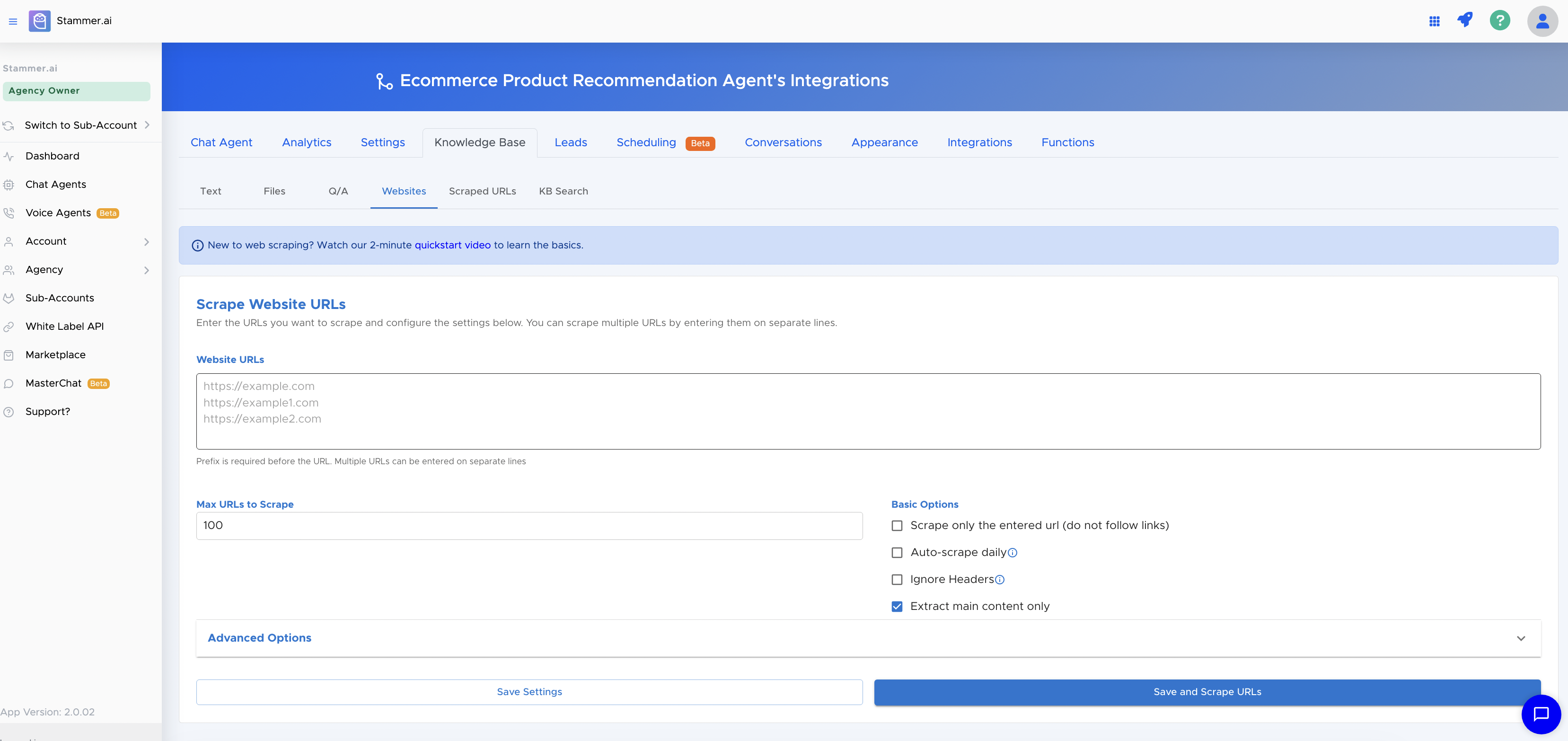
One of the biggest advantages of Stammer AI is that it supports many types of training data, not just plain text. This allows you to teach your AI agent using real business content in the formats you already have.
Type or Paste Text Directly: You can simply type or paste text into Stammer AI. This might include product descriptions, help guides, onboarding instructions, or customer service messaging. Starting with even simple text fragments (like greetings) helps your agent begin understanding conversational patterns and grow smarter from there.
Files: Upload files containing important business information. For example, PDFs, spreadsheets, or documents with service details. These files help the AI reference structured information when it answers customer questions.
Q&A Pairs: You can manually create specific question-and-answer pairs that train the bot on common customer queries. This is especially useful for frequently asked questions like “What are your hours?” or “How do returns work?”
Websites & Scraped URLs: Stammer AI can pull training data from your website pages or specific URLs. This helps the chatbot learn directly from content you’ve already published, such as product pages, support pages, or blog posts.
Knowledge Base (KB) Search: If you have an existing knowledge base, Stammer AI can draw from it when generating responses. Training your agent to search and reference KB articles improves the accuracy and relevance of replies the bot provides.
Training Better Responses from Live Interactions
Stammer AI also lets you improve the bot’s responses based on real conversations. Rather than only relying on initial data input, you can refine the AI after you see how it performs with actual users.
Train Better Response from the Dashboard:
While testing or interacting with your AI agent inside the Stammer dashboard, you can click a “Train Better Response” button if the bot’s answer isn’t what you expected. You then type the correct response you want it to use, and the system automatically adds this to the back‑end knowledge base for future use.
Train from the Conversations Tab:
You can also review past user conversations and correct responses after the fact. If the bot didn’t answer well or misunderstood a question, you can adjust the answer from the conversation history and save the corrected version into the bot’s training data.
Customization and Iteration
Training an AI agent with Stammer AI is an ongoing process. As your business changes (new products, updated policies, seasonal offers, etc.), you can update your training sources and retrain the agent. Adding new text, file data, or Q&A pairs keeps the bot’s knowledge current and relevant.
If the agent gives a wrong or unclear answer, you can correct it, and the AI will learn from that update. You can also adjust how the AI responds so it matches your brand’s tone and style. Over time, as more customers interact with the agent, these updates help it understand questions better and give improved responses. This ongoing process helps your AI agent grow smarter and provide a better experience for your customers.
Best Practices for Optimizing AI Agent Performance
Once your AI agent is trained, the next step is to make sure it performs well in real customer conversations. Following these best practices will help your chatbot stay accurate, helpful, and reliable over time.
Ensure a Diverse and Representative Dataset
Your AI agent should be trained using data that reflects the many different ways customers ask questions. Customers may use different words, tones, or sentence styles to ask the same thing. Training your AI with a wide variety of examples helps it understand and respond correctly to more situations.
Diverse data also helps reduce bias. If an AI is trained on limited or one-sided data, it may misunderstand certain users or give unfair responses. Including data from different customer scenarios, locations, and communication styles helps create a balanced and fair AI agent.
Continuous Learning and Adaptation
AI agents perform best when they continue to learn over time. As your business grows, customer questions change, and new products or policies are introduced, your AI should be updated with fresh information.
Stammer AI makes this easy by allowing you to retrain your agent using new text, updated files, or corrected responses from real conversations. Feedback loops where you review conversations and fix incorrect answers help the AI improve with every update.
Utilizing Transfer Learning
Most modern AI platforms use pre-trained models as a starting point. This means the AI already understands basic language before you train it on your business content. This approach, called transfer learning, saves time and improves accuracy.
For example, instead of teaching the AI what common words mean, you only need to teach it about your products, services, and customer needs. This helps your AI agent learn faster and perform better with less effort.
Testing and Evaluation
Testing your AI agent is important to make sure it’s meeting your expectations. You can set simple performance benchmarks, such as how often the AI gives correct answers or how quickly it resolves customer questions.
Reviewing conversation history helps you see where the AI performs well and where it struggles. Most importantly, user satisfaction at the end of the conversations is the best measure of success.
Conclusion
Training AI agents is an ongoing process that helps them work more effectively over time. When trained with the right information and updated regularly, AI agents can handle customer questions accurately and consistently. Stammer AI makes it easier for business owners to manage this process without technical knowledge.
By reviewing conversations, updating training data, and making small improvements when needed, AI agents can adapt as business needs change. With a thoughtful approach to training, AI agents can become a dependable tool that supports everyday customer interactions and helps businesses operate efficiently.