Best AI Customer Support Agents: Top Picks by Use Case
A customer messages your support line at 11pm asking why their order never arrived. In the old model, that message sat in a queue until morning, when a human agent opened it, looked up the order, checked the shipping status, compared it against your refund policy, and finally replied.
The customer waited hours for an answer that required no judgment, only steps. That gap between a simple request and a slow resolution is exactly what AI agents now close. The trouble is that most tools marketed as AI agents do not actually resolve anything. They answer questions, surface help articles, and hand the real work back to a person.
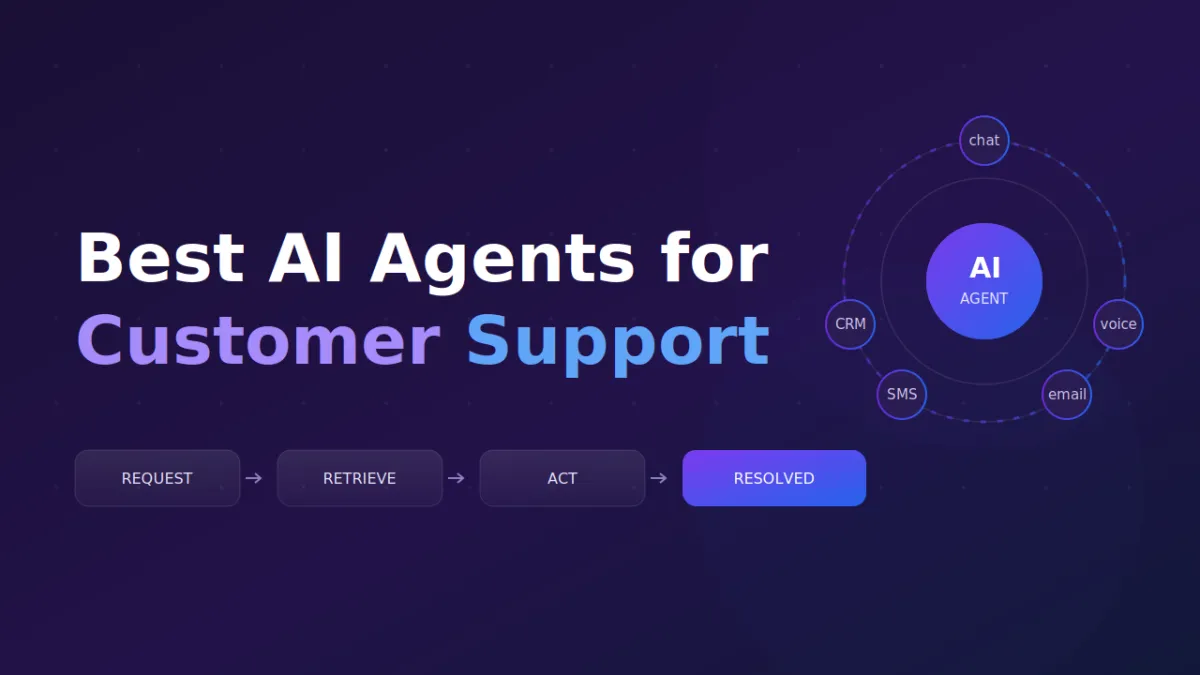
A genuine AI support agent does the opposite. It reads the request, pulls the order record, checks the policy, issues the refund, and tells the customer the problem is solved. This guide explains what separates a true support agent from a dressed-up chatbot, how to evaluate one, and which platforms lead the market.
What Separates an AI Agent From a Support Chatbot
The words get used interchangeably, but the difference is the whole point. A chatbot manages a conversation. It matches a question to an answer, offers a canned response or a link, and contains the interaction until a human takes over. Nothing changes in your business systems as a result.
An AI agent finishes the job. It understands the request in context, retrieves the relevant account and policy data, executes an action in a connected system, and closes the loop with the customer. A chatbot tells someone how to request a refund, an agent processes the refund and confirms it.
A true AI customer support agent typically does the following.
Resolves requests end to end without routing every case to a person.
Takes real actions in connected systems, such as updating an order, changing a booking, or issuing a credit.
Holds context across a conversation so the customer never repeats themselves.
Hands off to a human with the full history attached when a case needs judgment.
Some platforms in this category are agents in the full sense, while others are strong chatbots with an agentic label. If your goal is deflection and self-service, a capable white label AI chatbot may be enough. If your goal is autonomous resolution, hold vendors to the higher bar.
How to Evaluate an AI Customer Support Agent
Before comparing providers, establish the criteria that will determine whether an AI customer support agent can deliver results in a real support environment. Many buying decisions go wrong because a solution performs well in a demo but struggles with the complexity and volume of day-to-day customer interactions.
1. Resolution Rate:
Resolution rate is one of the most important metrics, but it needs careful scrutiny. Vendors may define "resolution" differently, and some may classify a conversation as resolved simply because the customer stops responding. Ask how resolution is measured, what qualifies as a successful outcome, and whether the results have been independently validated.
2. Channel Coverage:
Channel coverage determines where the agent can support customers. A text-based agent may work well for chat but offer little value to customers who prefer phone or messaging apps.
Confirm which channels the platform supports, including chat, email, voice, and messaging apps. Integration capabilities are equally important. An agent should connect with systems such as your CRM, help desk, order management platform, and knowledge base so it can take action rather than simply provide information.
3. Pricing:
Pricing structure has a major impact on the actual cost of deployment. Providers may charge per conversation, resolution, outcome, or through an enterprise contract. Each model has different cost implications.
For example, per-conversation pricing can increase costs even when conversations do not result in successful resolutions. Evaluate pricing against your expected support volume, resolution rates, and human support requirements rather than relying on the headline price.
4. Deployment and Governance:
Deployment and governance should also be part of the evaluation. A capable agent that takes months to deploy can delay the benefits you expect from automation.
Businesses also need clear controls around monitoring, escalation, data access, and auditing. The right solution should be powerful enough to automate meaningful support work while giving your team sufficient visibility and control.
5. Hidden Costs:
One cost is easy to overlook. AI-only customer support platforms often still require a separate help desk for human agents who handle escalations and complex cases. This can introduce additional per-seat costs that are rarely included in the initial pricing discussion.
Your total cost should therefore account for both the AI platform and the human support infrastructure required to operate it effectively.
The Best AI Agents for Customer Support
The platforms below cover different segments of the AI customer support market, from enterprise solutions and help-desk-native tools to white-label platforms built for agencies. Each profile focuses on what the platform does best, who it is suited for, and the key factors to consider.
1. Stammer AI

Stammer AI is a white-label AI platform for building and deploying chatbots and voice agents under your own brand. It allows agencies and resellers to create AI support solutions for multiple clients without developing the underlying technology themselves.
Best For
Agencies, marketing firms, and resellers that want to offer AI-powered customer support as a recurring service.
Customer Support Capabilities
Stammer AI can be used to automate common customer support interactions across chat and voice channels. Key capabilities include:
24/7 AI support: Handle routine customer questions outside business hours without human intervention.
Knowledge-based responses: Train AI agents on company-specific information, FAQs, documents, and other knowledge sources.
Lead and customer conversations: Engage visitors, answer questions, and collect relevant information during conversations.
Voice support: Deploy AI voice agents to handle inbound phone conversations alongside text-based support.
Task automation: Configure agents to perform actions and workflows rather than limiting them to simple question-and-answer interactions.
Human escalation: Route conversations to a human team when an issue requires personal assistance or falls outside the agent's capabilities.
Multi-client deployment: Agencies can create separate support agents and knowledge bases for different clients.
Key Strengths
Full white-label control: Brand the platform, dashboard, and AI agents as your own.
Chat and voice agents: Support both text and phone-based customer interactions.
Multi-client management: Manage AI deployments across multiple client accounts from one platform.
Custom knowledge sources: Train each agent on a client's business information to provide relevant and context-aware responses.
Trade-Offs to Consider
Stammer AI is built around the agency and reseller model. Businesses looking for a single AI agent for their internal support operation may not need its white-label and multi-client capabilities.
2. Sierra

Sierra provides enterprise-grade AI customer support agents designed around each company's brand, workflows, and customer experience. Its agents operate as an autonomous layer across existing support systems, handling conversations and taking actions on behalf of the business.
Best For
Large enterprises that need a highly customized AI support experience and have the budget, technical resources, and implementation capacity for a managed deployment.
Customer Support Capabilities
Sierra focuses on automating complex customer service interactions rather than limiting agents to basic FAQ responses. Key capabilities include:
Conversational customer support: Deliver natural, brand-specific interactions across customer touchpoints.
Action-oriented workflows: Agents can take actions within connected business systems instead of simply providing information.
Multi-channel support: Handle customer interactions across multiple channels through a unified AI layer.
Autonomous issue resolution: Manage support requests from initial conversation through resolution where the required workflows are available.
Brand customization: Adapt the agent's tone, behavior, and experience to match the company's brand.
Enterprise integrations: Connect with existing business systems and support infrastructure to execute customer requests.
Key Strengths
Sierra's main advantage is the level of customization and polish it brings to enterprise customer experiences. Its agents are designed to feel like an extension of the company's existing support operation rather than a generic chatbot.
The platform also emphasizes autonomous workflows, allowing agents to handle tasks and take actions across connected systems.
Trade-Offs to Consider
Sierra does not offer public pricing, self-serve signup, or a free trial, making it primarily an enterprise sales-led solution. Implementation can also require significant time and resources, particularly for businesses with complex systems and workflows.
As a result, Sierra is better suited to large organizations looking for a highly managed deployment than smaller teams seeking a quick, low-cost AI support solution.
3. Decagon

Decagon is an autonomous AI customer support platform designed for mid-market and enterprise teams. It combines AI-powered support with detailed workflow controls and analytics, giving businesses greater control over how agents handle customer interactions.
Best For
Mid-market and enterprise support teams with high ticket volumes that need a configurable AI agent, strong automation capabilities, and detailed performance insights.
Customer Support Capabilities
Decagon is designed to handle customer interactions across multiple support channels while following company-specific processes. Key capabilities include:
Multi-channel support: Handle customer conversations across chat, email, voice, and social channels.
Workflow automation: Configure agents to follow specific procedures and business rules when handling support requests.
Context-aware responses: Use customer and business data to provide more relevant support.
Human handoff: Escalate complex cases to human agents with the conversation context preserved.
Performance analytics: Monitor resolution rates, agent performance, and workflow outcomes to identify areas for improvement.
Continuous optimization: Use support data and analytics to refine agent behavior and improve workflows over time.
Key Strengths
Decagon stands out for its configurability and measurement. Teams can define how agents should behave, establish specific procedures, and use detailed analytics to evaluate performance.
Its ability to combine automated support with human escalation also makes it suitable for organizations handling a high volume of customer interactions.
Trade-Offs to Consider
Decagon does not publish public pricing, so costs typically depend on the scope and scale of the deployment. Implementation is also more suited to established support teams than businesses looking for a simple, self-serve solution.
The platform is most likely to deliver value for organizations with enough support volume and operational complexity to justify a more sophisticated AI deployment.
4. Intercom Fin

Fin is Intercom's AI customer support agent, built directly into the company's help desk. It is designed to resolve customer inquiries within the existing support environment rather than operating as a separate AI layer. Its proprietary Apex model is specifically optimized for customer service use cases.
Best For
Teams already using Intercom, or businesses looking to adopt a complete help desk and AI support solution with transparent pricing and a relatively straightforward deployment process.
Customer Support Capabilities
Fin focuses on resolving customer inquiries across the channels and workflows commonly used by modern support teams. Key capabilities include:
Multi-channel support: Handle conversations across live chat, email, WhatsApp, SMS, phone, and Slack.
Autonomous ticket resolution: Resolve customer requests without requiring human intervention when the agent has the information and permissions needed.
Knowledge-based support: Use a company's existing support content and knowledge sources to provide accurate responses.
Human escalation: Hand complex conversations to human agents when AI resolution is not appropriate.
Help desk integration: Operate directly within Intercom's support environment, keeping AI and human workflows in one system.
Performance tracking: Monitor AI resolution and support outcomes to evaluate automation performance.
Key Strengths
Fin's biggest advantages are its native help desk integration, broad channel coverage, and transparent pricing. Unlike many enterprise AI support platforms, Intercom provides a self-serve pricing model based on successful outcomes.
Intercom also reports a high level of autonomous resolution, making Fin one of the more established options for businesses looking to automate a significant portion of their support workload.
Trade-Offs to Consider
Fin's usage-based pricing means costs increase with the number of AI-resolved conversations, in addition to the cost of Intercom seats. Businesses should model expected support volume and resolution rates before committing.
There is also a longer-term consideration for buyers. Salesforce announced an agreement to acquire Intercom for approximately $3.6 billion in June 2026, subject to regulatory approval. While current pricing and packaging remain unchanged, businesses evaluating Fin for a long-term deployment should keep the acquisition and its potential impact on the product roadmap in mind.
5. Zendesk AI

Zendesk AI adds AI-powered automation and agentic capabilities to Zendesk's established customer support platform. It allows businesses to automate customer interactions while keeping AI, human agents, ticketing, routing, and reporting within the same support environment.
Best For
Organizations already using Zendesk that want to introduce AI-powered resolution without replacing their existing help desk and support infrastructure.
Customer Support Capabilities
Zendesk AI combines automated customer support with tools designed to assist human agents. Key capabilities include:
Automated ticket resolution: Handle routine customer requests without human intervention.
AI-powered routing: Automatically categorize, prioritize, and route support requests to the appropriate workflows or teams.
Agent assistance: Provide human agents with AI-powered suggestions and support during live customer interactions.
Workflow automation: Automate repetitive support tasks and common service processes.
Knowledge-based responses: Use existing support content and knowledge sources to provide relevant answers.
Unified reporting: Track AI and human support activity within Zendesk's existing reporting environment.
Key Strengths
Zendesk AI's biggest advantage is its native integration with the broader Zendesk ecosystem. Organizations can add AI automation without introducing an entirely separate support platform.
Its combination of automated resolution and AI assistance for human agents also allows businesses to automate routine requests while improving the productivity of their existing support teams.
Trade-Offs to Consider
Zendesk's pricing structure can become complex because AI resolution costs are layered on top of Suite seats and AI-related add-ons. Businesses should also account for usage-based charges when forecasting their total support costs.
A 2026 billing change introduced automatic overage charges once customers exceed their committed AI resolution volume, making accurate volume forecasting particularly important. Teams should model expected resolution volume before selecting a commitment level to reduce the risk of unexpected costs.
6. Ada

Ada is an AI customer experience automation platform designed to manage high-volume support across multiple channels and languages. Its AI agents provide a unified layer for automating customer interactions at scale.
Best For
High-volume and global support teams that need to automate customer service across multiple channels and languages from a single platform.
Customer Support Capabilities
Ada focuses on broad coverage and scalable automation. Key capabilities include:
Multi-channel support: Manage customer interactions across chat, email, voice, and SMS.
Multilingual support: Serve customers in multiple languages from the same AI support environment.
Automated resolution: Handle common customer requests without requiring human intervention.
Knowledge-based responses: Use company-specific content and information to provide relevant answers.
High-volume automation: Manage large numbers of customer conversations without increasing the size of the support team at the same rate.
Human escalation: Transfer conversations to human agents when an issue requires additional assistance.
Key Strengths
Ada's main advantage is breadth and scalability. Its ability to support multiple channels and languages makes it particularly suitable for companies with large or geographically distributed customer bases.
Trade-Offs to Consider
Ada is positioned primarily toward enterprise customers, with pricing typically based on custom contracts and deployments that can represent a significant annual investment.
As an AI-focused platform, businesses may also need a separate help desk or support system for human-agent workflows. That additional software and per-seat cost should be included when calculating the total cost of deployment.
7. Gorgias

Gorgias is an e-commerce-focused customer support platform built around the needs of online retailers. Its AI agent uses store data, customer information, and brand context to automate common support requests throughout the shopping journey.
Best For
E-commerce businesses and online retailers that need AI support for high-volume queries such as order tracking, shipping, returns, refunds, and product questions.
Customer Support Capabilities
Gorgias is designed around common e-commerce support workflows. Key capabilities include:
Order support: Provide customers with order status, shipping updates, and related information.
Returns and refunds: Guide customers through return processes and automate eligible requests.
Intent detection: Identify requests such as order tracking, returns, shipping, or product questions and trigger the appropriate workflow.
Multi-channel support: Handle customer interactions across chat, email, and contact forms.
Store integrations: Connect with e-commerce systems to access customers and order information during conversations.
Action-based support: Perform tasks such as updating orders or processing returns instead of simply providing instructions.
Brand-aware responses: Adapt responses to the retailer's brand voice and customer experience.
Key Strengths
Gorgias stands out because its AI capabilities are closely aligned with e-commerce support workflows. Rather than functioning as a general-purpose customer support agent, it is designed around the types of questions and actions that online stores handle every day.
Trade-Offs to Consider
Gorgias uses ticket-based pricing tiers, so support costs can increase during periods of high customer activity. Businesses with seasonal demand should account for potential volume spikes when evaluating the total cost.
Its e-commerce specialization is also an important consideration. The platform is particularly well suited to online retail, but businesses outside e-commerce may find its feature set less relevant to their support requirements.
Kore.ai

Kore.ai is an enterprise AI platform that provides customer service automation alongside broader conversational AI and workflow automation capabilities. Its platform supports complex service environments where multiple AI agents, channels, and business processes need to work together under centralized governance.
Best For
Large enterprises that require multi-agent orchestration, centralized governance, and AI automation across complex customer service operations.
Customer Support Capabilities
Kore.ai is designed to support complex customer service journeys across contact-center and conversational channels. Key capabilities include:
Multi-agent orchestration: Coordinate multiple specialized AI agents and workflows within a unified environment.
Voice and contact-center automation: Automate customer interactions across voice and contact-center workflows.
Omnichannel support: Support customer conversations across multiple channels through a connected AI layer.
Workflow automation: Automate repetitive service processes and business tasks.
Enterprise integrations: Connect AI agents with existing business systems and customer service infrastructure.
Centralized governance: Manage agent behavior, security, access, and performance through enterprise-level controls.
High-volume support: Scale AI-driven interactions across large customer service operations.
Key Strengths
Kore.ai's primary advantage is its combination of scale, orchestration, and governance. Rather than focusing solely on individual customer conversations, it provides infrastructure for coordinating multiple agents and automated workflows across complex service environments.
Trade-Offs to Consider
The platform's breadth also introduces additional complexity. Organizations may need significant technical resources and internal expertise to configure, integrate, and manage a multi-product enterprise deployment.
For smaller support teams with straightforward automation requirements, Kore.ai may offer more functionality than they need. It is better suited to enterprises with complex workflows, high interaction volumes, and the resources to manage a sophisticated AI environment.
How to Choose the Right AI Support Agent
The right platform depends on your support volume, business model, and existing tech stack.
Frequently asked questions
What is an AI agent for customer support?
An AI agent for customer support is a system that resolves customer requests end to end. It understands the request, retrieves the relevant account and policy data, takes the required action in connected business systems, and closes the loop with the customer, without a human handling every case.
How is an AI agent different from a chatbot?
A chatbot answers questions and contains a conversation, often pointing customers to help articles or canned responses. An AI agent goes further and completes the task, executing actions like a refund or a booking change inside your systems, then confirming the resolution.
What is a good resolution rate for an AI support agent?
Resolution rates vary by platform and by how each vendor defines resolution. Leading platforms report autonomous resolution in the range of roughly three-quarters of eligible volume, though the exact figure depends on the definition, the channel, and the complexity of the requests. Always ask how a vendor measures the number before comparing claims.
Can an agency white-label an AI support agent?
Yes. Platforms like Stammer AI are built for exactly this. An agency can brand the agent as its own product, deploy it across multiple client accounts, set its own pricing, and own the client relationship rather than reselling a vendor-branded tool.