
Best White Label AI Software for Agencies and Resellers
Most agencies hit the same ceiling. Services revenue is capped by the hours in a week, and every new client means more delivery work rather than more margin. White label AI software breaks that pattern.
It lets you take a finished, maintained platform, put your own brand on it, and sell it to clients as your own product, which turns one-off project fees into recurring subscription income you keep expanding without writing code.
The catch is that not every platform marketed as white label actually lets you own the brand and the client relationship. Some only hide a logo. Others stop at co-branding, where the vendor stays visible.
This guide explains what real white label AI software looks like, how to judge one platform against another, and which providers are worth reselling. It leads with the specialist option for agencies whose core product is AI, then covers established platforms across marketing, websites, content, reporting, and fulfillment.
What Is White Label AI Software
White label AI software is a ready-built AI product that one company develops and another rebrands and resells as its own. The vendor maintains the underlying technology, the models, the infrastructure, and the updates, while the reseller controls the brand, the pricing, and the client relationship.
Your clients log in to a product that carries your logo, your colors, and your domain, and in a true white label setup they never see the vendor's name at all. True white label means you rebrand and resell the product under your own identity, usually with a separate account for each client that you bill directly.
Co-branding places your logo alongside the vendor's, so the client still sees who built the software. Affiliate or referral partnerships pay you a commission but leave the brand and the billing with the vendor. For an agency trying to build a software business, only the first model gives you the brand equity and the client ownership that make the effort worthwhile.
The appeal for agencies is straightforward. You skip the cost and the years of building a platform, you add a product line with high margin, and you deepen client relationships because the software carries your name.
When a client relies on a tool that looks like yours, switching away from you gets harder, which is why white label resale tends to hold clients longer than pure service work.
How to Choose a White Label AI Platform
The right platform depends on what you want to sell and who you sell it to. Before comparing names, it helps to weigh each option against a consistent set of criteria so the decision rests on fit rather than marketing.
Branding depth is the first test. Look for a custom domain, your own logo and colors, a branded login screen, and confirmation that the vendor is fully hidden from the client. Anything less than that is co-branding wearing a white label label.
Client management comes next. Strong platforms give you a separate sub-account for each client, let you set your own prices, and handle rebilling so you keep the margin between your price and your wholesale cost. The billing model matters as much as the features, since it decides how your profit scales.
Product fit is where many agencies go wrong. A platform is only useful if its core product matches what your clients actually want to buy, whether that is AI chat and voice, websites, content, marketing automation, or reporting.
Pricing structure shapes your economics too, because a flat platform fee, a per-account wholesale rate, and a usage-based model each reward a different scale of business.
Finally, weigh credentials and support, meaning the provider's track record, its partner or customer base, its standing on review platforms, and the help you can lean on when a client has a problem.
The 10 Best White Label AI Software Platforms
The platforms below are grouped by primary strength, and each one is a genuine white label or reseller solution rather than a co-branding arrangement. The list opens with the specialist choice for agencies selling AI, then moves through the broader platforms that agencies rebrand across marketing, websites, content, reporting, and fulfillment. Verify current pricing and terms directly with each provider before you commit, since white label programs change.
1. Stammer AI
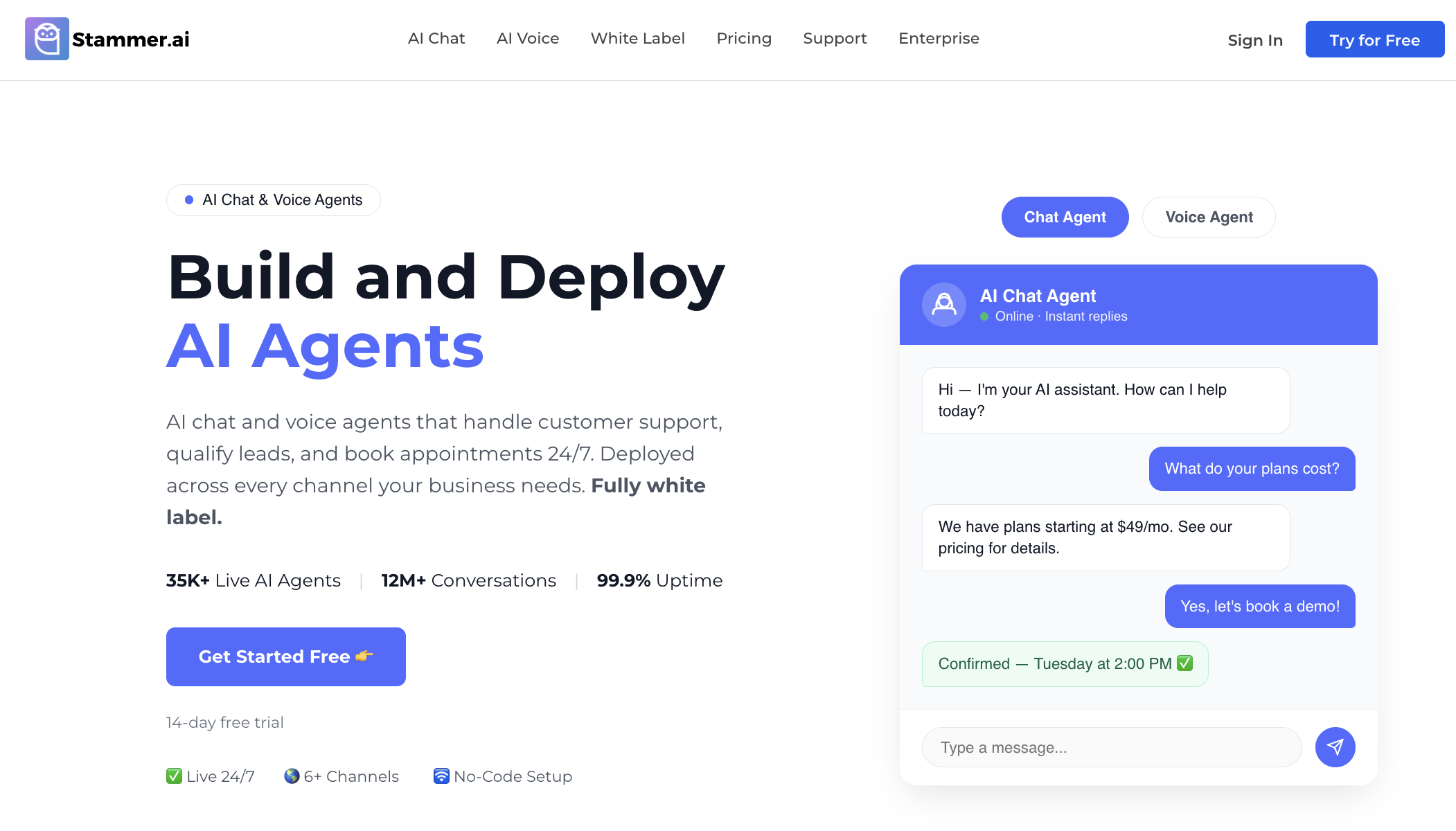
Stammer AI is the most focused platform on this list, built for one job, helping agencies resell AI chatbots and voice agents under their own brand. Where broader suites treat AI as one feature among many, Stammer makes branded AI agents the whole product. Clients log in to a dashboard that carries your name, and the platform stays invisible behind it.
Key white-label features
Stammer covers both chat and white label AI voice agents in a single platform, deployed on your own domain with your branding throughout, including the client-facing dashboard. Each client gets a sub-account, and the billing runs on a wallet model where clients prepay and usage draws the balance down.
You set the markup on every message and every voice minute, and you keep that margin in full. Because chat and voice sit together, you can expand a client from one service to the other without adding a second vendor.
Best use cases
Stammer fits agencies whose core offer is AI, or service businesses adding AI as a productized line. A marketing agency can resell branded support chatbots to local businesses, a consultant can package voice agents for clinics and dealerships that need after-hours call handling, and an automation shop can run both under one roof. It suits operators who want the AI itself to be the product, not a bolt-on to a marketing stack.
Pricing model
Stammer supports agencies and businesses with AI chat and voice agent solutions. The Pro plan starts at $99/month and includes white-label capabilities and reselling features, while higher-scale Enterprise solutions are available with custom pricing. Agencies can package Stammer’s AI services into their own offerings and create pricing models based on their client needs.
Credentials and reputation
Stammer AI is positioned specifically around agency resale, and independent roundups of white label AI tools consistently describe it as the option built for the agency reselling AI agents, singling out its wallet-based billing and its combined chat and voice coverage.
For agencies weighing purpose-built AI platforms, that specialist focus is the differentiator. A handful of dedicated chatbot competitors exist in the same niche, but they tend to cover chat alone or lack the reseller-first billing that defines Stammer.
2. GoHighLevel
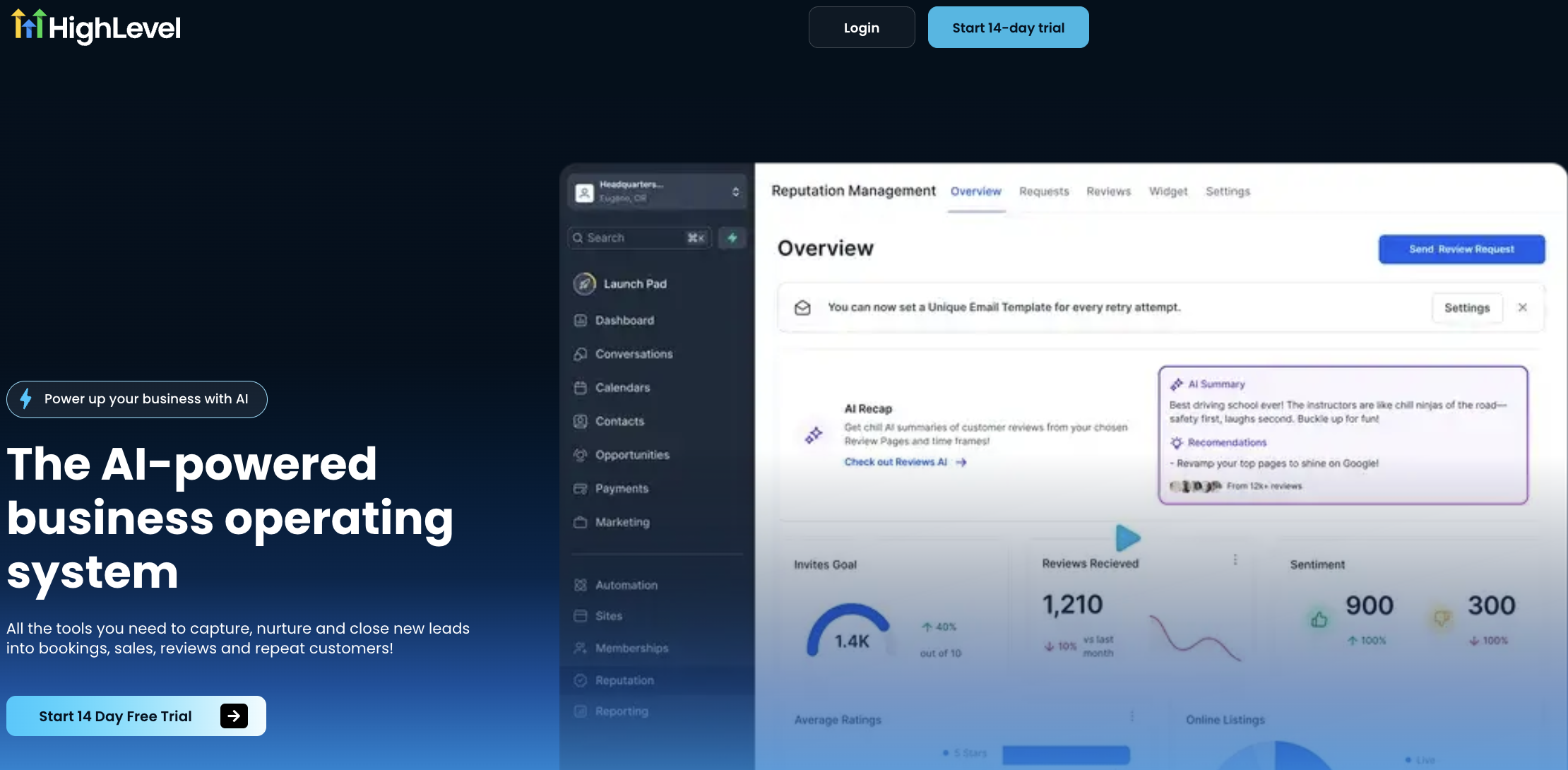
GoHighLevel is the best-known white label platform in the agency world, built around CRM and marketing automation rather than AI specifically. Agencies rebrand the entire platform and resell it as their own software, with a growing AI layer bundled on top. It is the default choice for marketing agencies that want a broad client-management stack under their own name.
Key white-label features
The platform's SaaS Mode lets you resell GoHighLevel as branded software, set your own prices, connect Stripe, and have the platform bill your clients and spin up a sub-account for each one automatically.
On the higher tiers you apply your own logo, domain, and colors, and clients log in at your URL without seeing GoHighLevel. Its AI Employee add-on bundles conversational AI, voice, content generation, and workflow automation into something you can rebill to every client sub-account.
Best use cases
GoHighLevel suits marketing agencies serving local businesses that need lead generation, nurture sequences, SMS, pipelines, and calendars in one place. It works best when the agency wants to sell a full marketing operating system rather than a single AI tool, and when AI is one part of a wider service bundle rather than the headline product.
Pricing model
White label branding starts on the Unlimited plan, and SaaS Mode with automated client billing and custom pricing tiers unlocks on the Pro plan at roughly 497 dollars per month, which includes unlimited sub-accounts.
Your cost stays fixed while you add clients, so margin improves as you scale. Metered SMS, email, and AI usage are billed on top, which agencies need to price into their client tiers.
Credentials and reputation
GoHighLevel has one of the largest agency communities in the category and is widely treated as the benchmark for white label CRM. Industry roundups regularly describe it as the deepest white label infrastructure in the agency space, citing its automated account creation, dunning, and Stripe billing. Common criticisms center on shared-IP email deliverability and surprise usage invoices, both of which are manageable with careful setup.
3. Vendasta
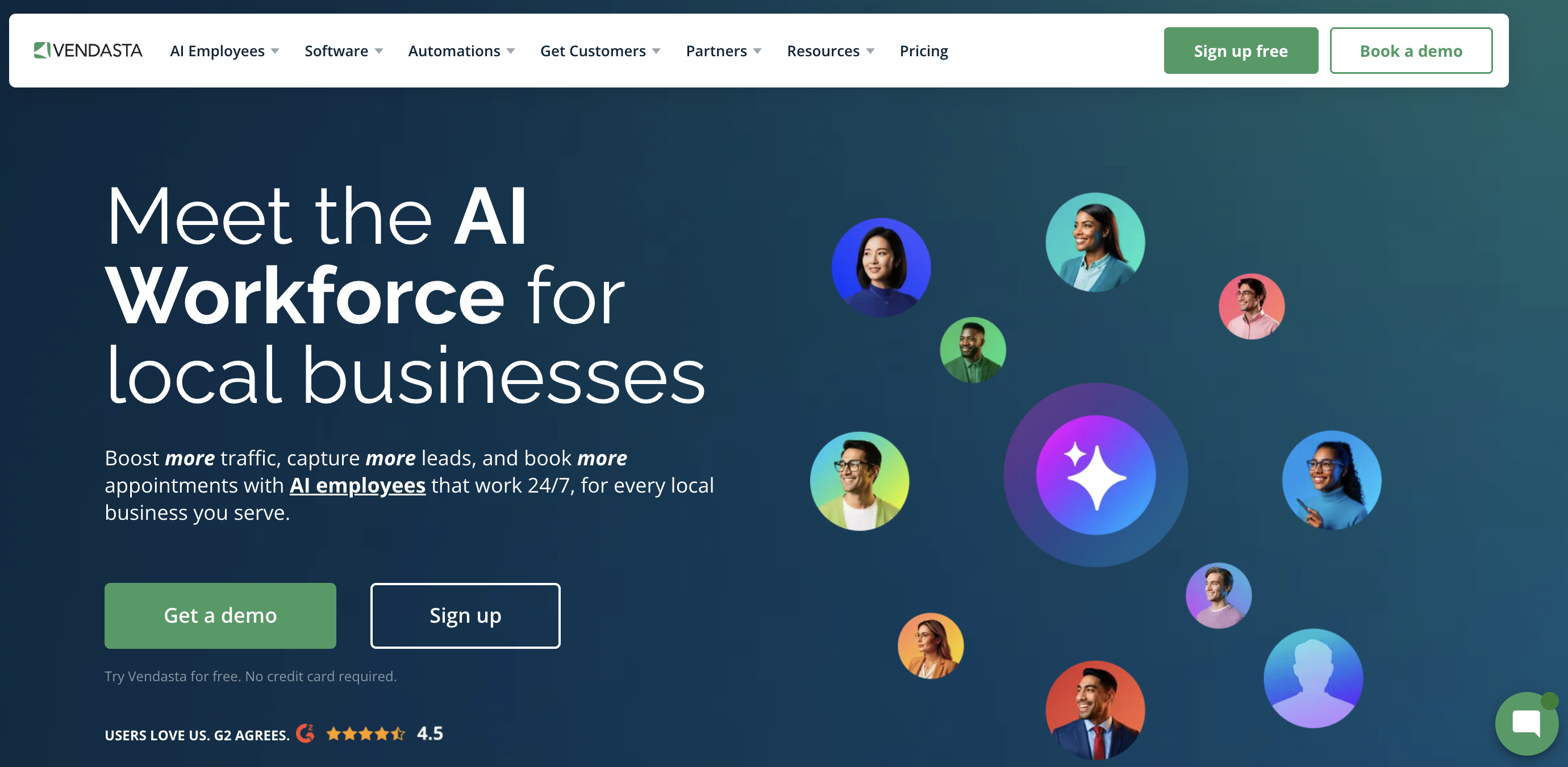
Vendasta is less a single product than a white label marketplace. Agencies resell an entire catalog of rebranded digital products and services under one brand, from listings and reputation management to websites and SEO, with a growing set of AI tools alongside. It is aimed at agencies that want breadth without building or delivering anything themselves.
Key white-label features
The platform combines a marketplace of white label apps with a branded client portal, a sales CRM, and marketing automation. Its distinguishing feature is white label fulfillment, where Vendasta's in-house teams deliver the services you sell under your brand while you own the client relationship. Its newer AI workforce adds branded AI roles such as a receptionist, a sales assistant, and a support agent.
Best use cases
Vendasta fits local-marketing and media agencies that serve small businesses and want to be a one-stop digital partner. It works well when an agency would rather resell and orchestrate a wide range of products than specialize, and when outsourced fulfillment matters because the team is small relative to the client load.
Pricing model
Vendasta uses tiered subscriptions plus wholesale pricing on each marketplace product, with white label branding gated above the entry tier. The economics depend on understanding wholesale costs per product rather than a single flat fee, so agencies need to model the stack carefully.
Credentials and reputation
Vendasta is an established name in the agency reseller space and reports a partner base in the tens of thousands running on its platform. Reviews credit its product breadth and fulfillment model, while the recurring criticism is stacked cost, since platform fees, per-product wholesale, seats, and onboarding can compound. It is a mature option rather than a lean one.
4. SuiteDash
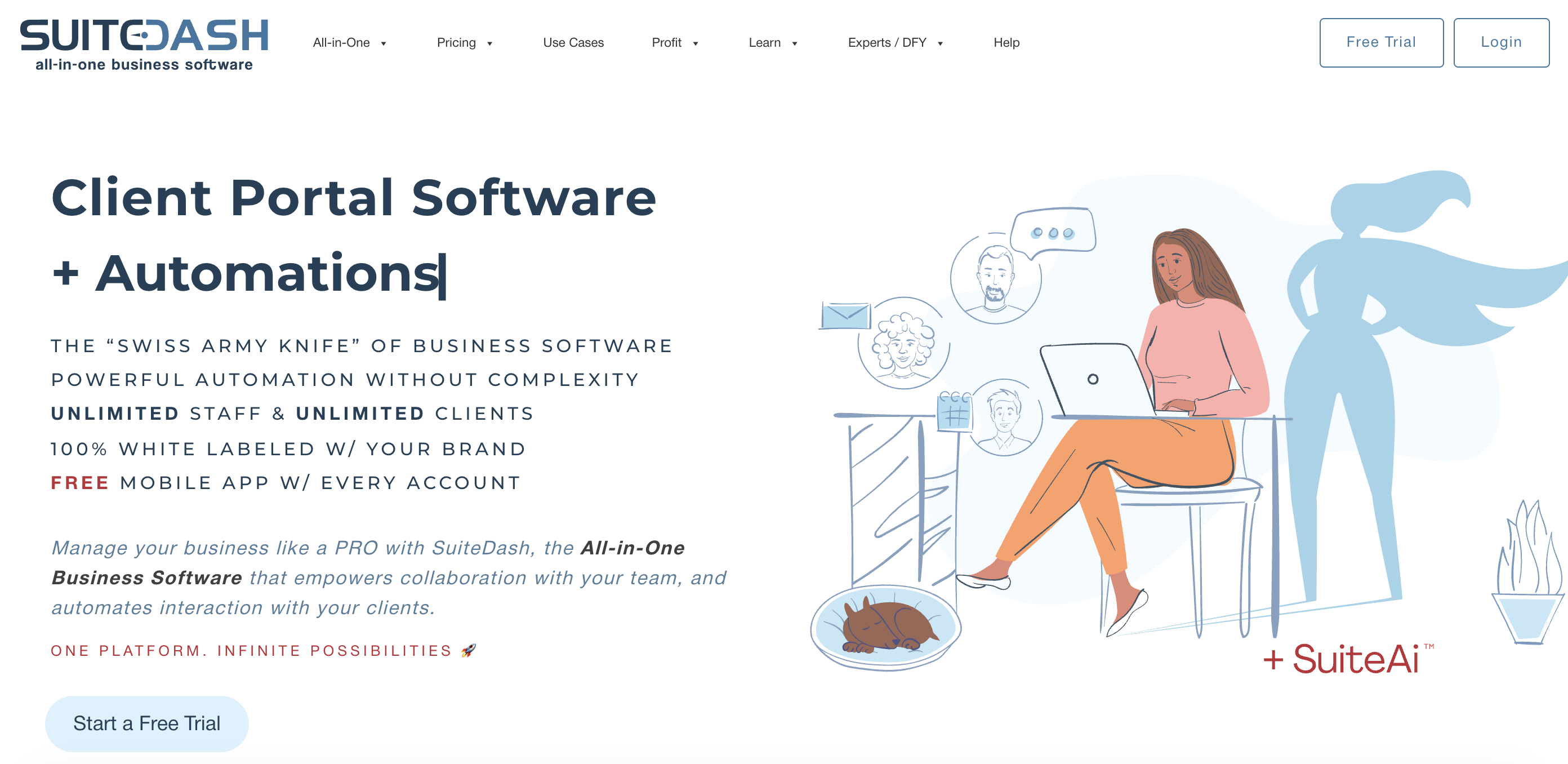
SuiteDash is a white label client portal and business operations platform. Rather than marketing tools, it centers on the systems agencies and service firms use to run client work, spanning CRM, project management, invoicing, and file sharing. Its reseller program lets you offer the whole suite under your own brand.
Key white-label features
SuiteDash offers deep rebranding, described by the company as extreme white labeling, with a custom domain, a custom login, a branded email sender, and a branded mobile experience so clients never encounter the SuiteDash name.
Its reseller dashboard lets you create and manage child accounts, set your own markup over a wholesale per-account price, and hand clients admin-level access to a fully branded environment.
Best use cases
SuiteDash suits agencies, consultants, accountants, and other service firms whose clients would value a branded portal for documents, invoicing, and light CRM. It fits operators who want to resell a unified operations platform to a range of vertical clients, and it works especially well when packaged alongside advisory services.
Pricing model
SuiteDash is known for flat, unlimited pricing that does not charge per client or per staff member, which keeps costs predictable as you grow. Its reseller program runs on a wholesale per-account rate that you mark up, and the program is application-based with no upfront fees. That predictability is a large part of its appeal for margin planning.
Credentials and reputation
SuiteDash has been in the market since the mid-2010s, giving it a decade of feature maturity, and it is frequently recommended for agencies wanting genuine infrastructure white label rather than a logo swap. Its long track record and unlimited pricing model draw consistent praise, while its breadth means a steeper initial learning curve than single-purpose tools.
5. ActiveCampaign

ActiveCampaign is a marketing automation, email, and CRM platform that agencies can rebrand through its Agency Partner program. It brings lifecycle marketing, automated customer journeys, and increasingly AI-assisted features into a product you resell under your own name. The focus is email and automation rather than AI as a standalone product.
Key white-label features
Under the White Label Agency Partner Program, you offer the service under your own brand, purchase discounted accounts, and bill your clients directly. Rebranding through the Agency Dashboard replaces the ActiveCampaign logo and favicon with your own, hides help links and vendor information, and lets you rename the product, applied across existing or new client accounts.
Best use cases
ActiveCampaign fits agencies that deliver email marketing, automation, and CRM services and want to wrap them in their own brand. It suits teams building nurture sequences and segmented campaigns for clients, and it works best when marketing automation is the service the agency leads with rather than a secondary add-on.
Pricing model
Agency Partners are billed monthly per paid, active resold account, and the per-account cost falls as you add more accounts. ActiveCampaign does not bill your clients, so you set your own pricing, collect payment, and manage the margin between your price and the discounted rate. That volume discount rewards agencies that grow a sizable book of resold accounts.
Credentials and reputation
ActiveCampaign is a widely used automation platform with a long-standing agency and consultant partner program, and its white label rebranding is documented and actively maintained. It is a credible, established choice for agencies whose service centers on email and automation, though its white label controls are lighter than platforms purpose-built for full software resale.
6. 10Web
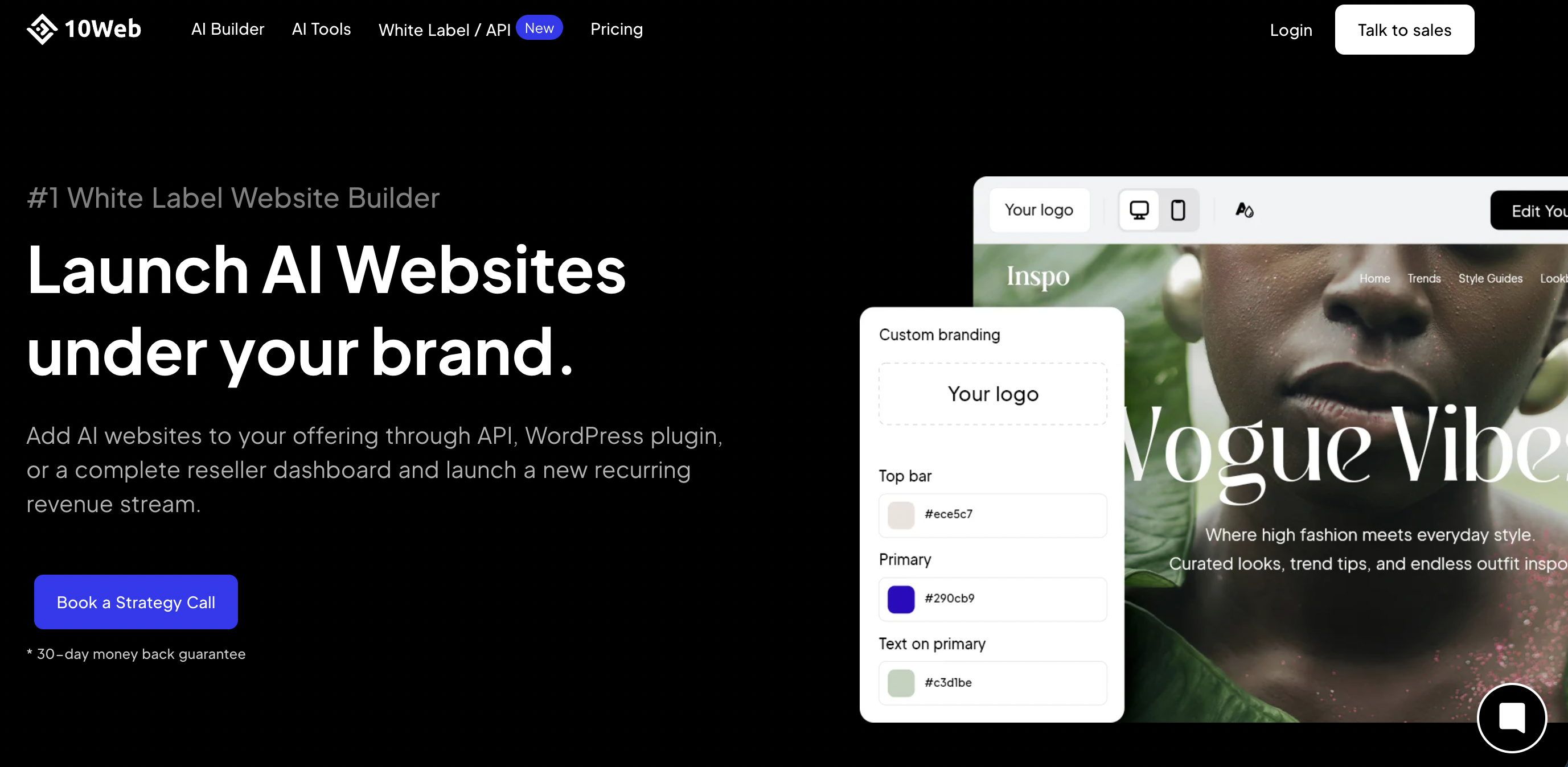
10Web is a white label AI website builder that generates branded WordPress sites from a prompt. Agencies and resellers use it to offer AI-assisted site creation under their own name, with hosting handled behind the scenes. Its niche is website production rather than conversation or marketing automation.
Key white-label features
The platform generates a complete, mobile-ready site, including structure, content, images, and design, from a description of the business. Clients interact with a custom dashboard, editor, and admin area that show only your branding. For agencies that want to trigger site generation from their own systems, 10Web also exposes a website builder API, so the capability can be embedded into an existing platform.
Best use cases
10Web suits web design agencies, SaaS platforms, and resellers that want to deliver WordPress sites quickly with recurring hosting and maintenance revenue attached. It fits teams that sell websites as a productized service and want rapid build times without expanding their design headcount, while 10Web handles hosting, uptime, and security.
Pricing model
10Web offers agency and reseller plans with dashboard and domain customization, bundling AI site generation with managed WordPress hosting. Pricing scales with the number of sites and the level of white label control, and the model pairs an initial build sale with an ongoing care plan for stable recurring revenue. Confirm current plan tiers on the provider's site.
Credentials and reputation
10Web is an established name in AI-assisted WordPress building and appears consistently in roundups of white label AI tools for agencies. Its combination of AI generation, managed hosting, and API access is what reviewers highlight, and it is regarded as a practical option for agencies scaling website delivery rather than a general-purpose platform.
7. Writesonic
Writesonic is an AI content generation platform with a white label reseller program. Agencies rebrand the tool and resell it to clients as their own content product, turning AI writing into a recurring line rather than a per-project cost. Its focus is written content, from articles to ad copy.
Key white-label features
The reseller program lets agencies deploy the platform under their own domain with full branding across the interface. A reseller dashboard handles client billing, per-account usage tracking, and custom pricing tiers, so you can package content generation as a standalone branded product. Automated blog workflows let clients set parameters and schedule generation without manual triggers.
Best use cases
Writesonic fits agencies that offer content services and want to give clients a branded self-serve writing tool, or that need bulk content generation across many accounts. It suits budget-conscious teams testing an AI content line, and it works well when content is a core deliverable the agency wants to productize rather than deliver by hand each time.
Pricing model
Writesonic pairs accessible subscription pricing with a white label reseller program layered on top, and the reseller dashboard lets you set client pricing tiers and track usage per account. The entry cost is low relative to broader suites, which lowers the barrier for agencies validating demand before committing to a larger content offer.
Credentials and reputation
Writesonic is a recognized AI writing platform that appears regularly in white label content tool comparisons, credited for its reseller infrastructure and custom-domain branding. Its reputation is strongest among agencies that want volume content generation with reseller economics, and the trade-off, as with most content AI, is that output still benefits from human editing before it reaches a client.
8. DashClicks
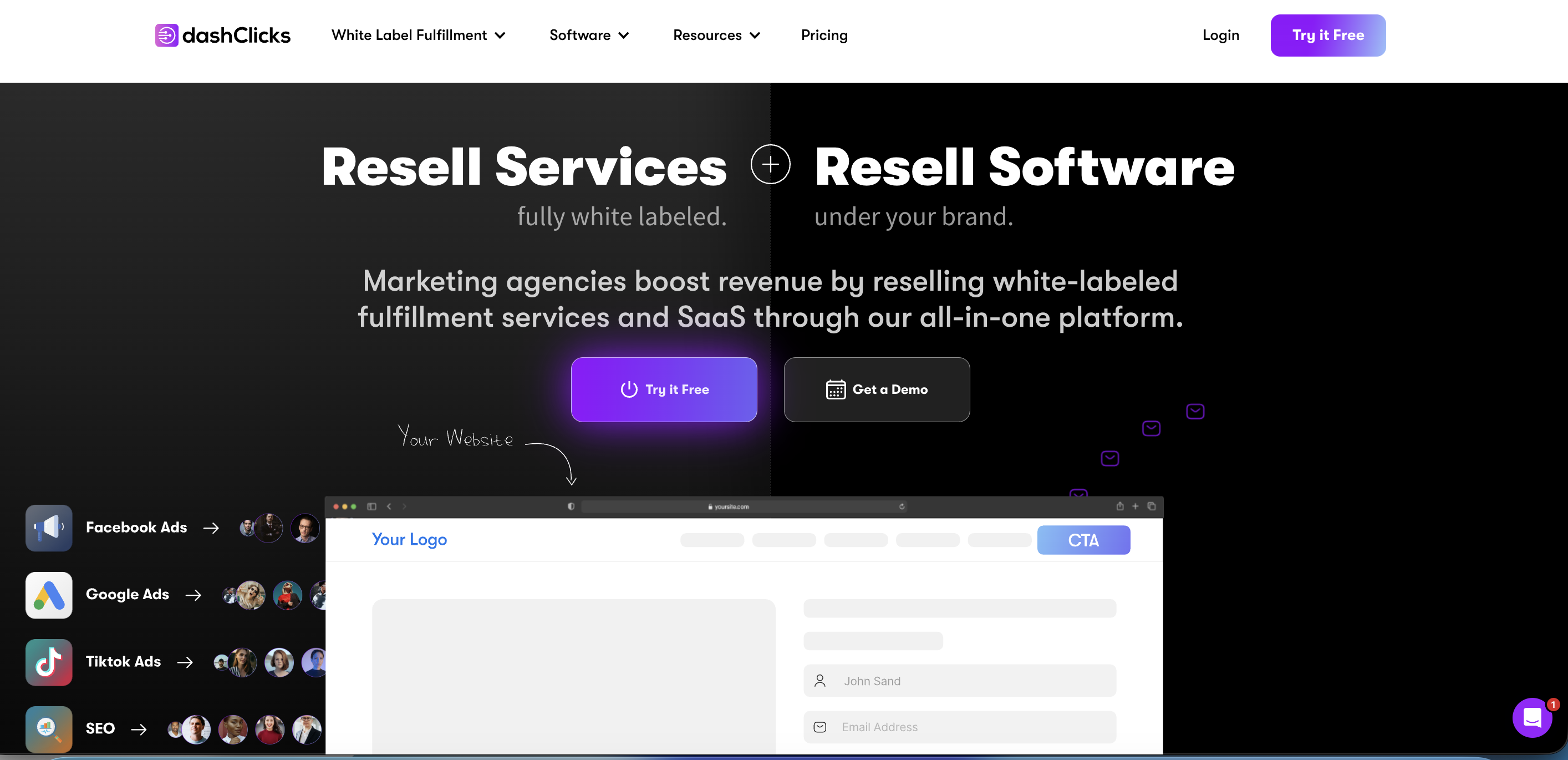
DashClicks combines white label software with done-for-you fulfillment for marketing agencies. Agencies resell both the platform and the services delivered through it, all under their own brand, which makes it a hybrid of software and outsourced delivery rather than a pure product.
Key white-label features
The platform pairs agency management software with a marketplace of white label fulfillment services such as SEO and paid advertising. It includes a branded client portal, a built-in CRM, reputation management, a drag-and-drop website builder with white label capabilities, and automated re-billing. The unified dashboard gives clients visibility into every service you provide without revealing the fulfillment relationship behind it.
Best use cases
DashClicks suits agencies serving small and medium businesses that need several digital services at once, letting a small team act as a full-service provider without building each capability in-house. It fits operators who want software and fulfillment in one place, and who value being able to test the tools before committing to paid services.
Pricing model
DashClicks lowers the barrier to entry with free platform access, so agencies can use the software and prospecting tools before buying fulfillment services. You pay wholesale for the fulfillment services you resell and mark them up for clients, which keeps the model flexible for agencies at different stages. Confirm current terms directly, since access tiers and service pricing can change.
Credentials and reputation
DashClicks carries verified review coverage across Capterra, GetApp, and Software Advice, where agency owners consistently praise its ease of use, competitive pricing, and seamless white label options. Reviewers note that clients never see the third-party relationship, and the recurring critique concerns the CRM and contact management, which some find less polished than the rest of the suite.
9. AgencyAnalytics
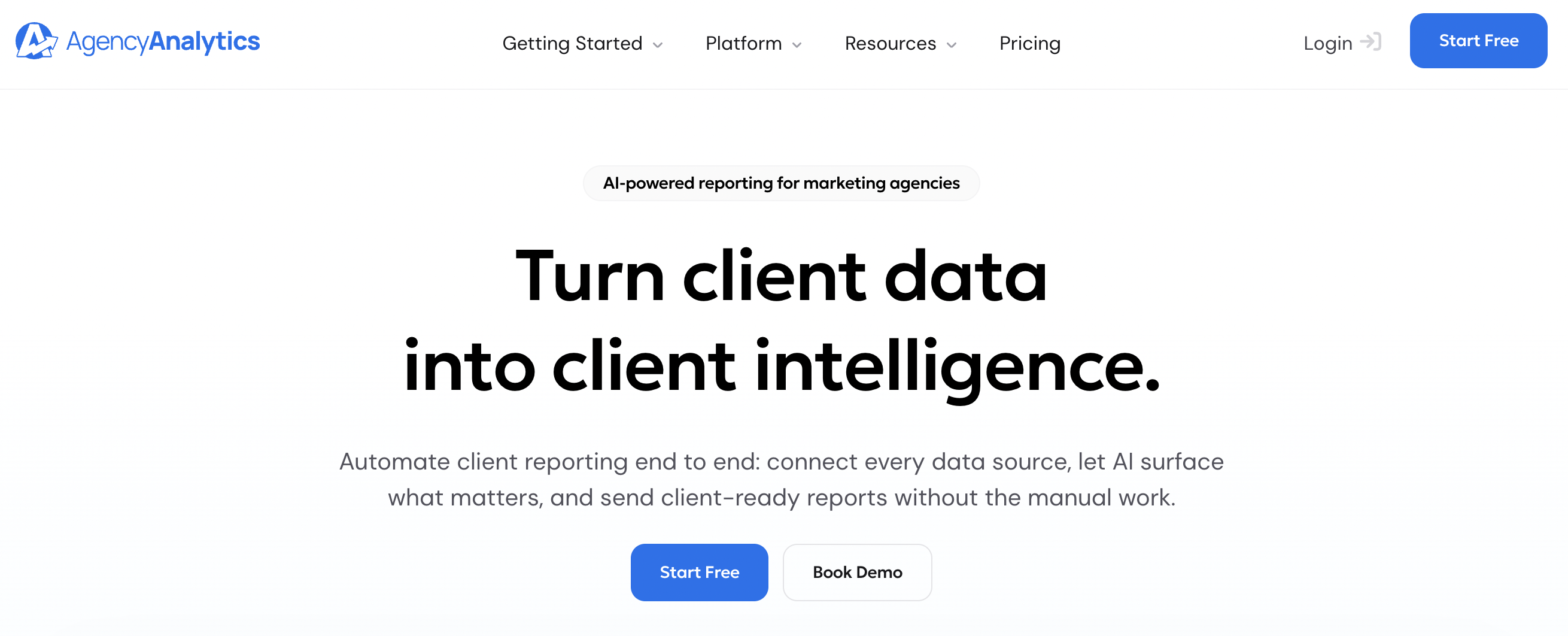
AgencyAnalytics is a white label client reporting platform built specifically for marketing agencies. It pulls data from across a client's marketing channels into branded dashboards and automated reports, solving the scattered, manual reporting problem that eats agency time. Its niche is reporting rather than campaign execution.
Key white-label features
The platform delivers a custom dashboard domain, your logo and colors, branded PDF report covers, and a client portal that looks like your own software. Clients get their own logins to view live dashboards, and reports can be scheduled and sent automatically. It connects to more than 80 marketing data sources across SEO, PPC, social, email, and analytics, with newer AI summaries drafting the performance narrative for you to refine.
Best use cases
AgencyAnalytics fits agencies managing a handful to a few dozen clients that need consistent, branded reporting in one place. It suits SEO-led and full-service agencies that want clients checking a single portal rather than chasing report links, and account teams that need to spin up reporting for new clients quickly without building templates from scratch.
Pricing model
AgencyAnalytics uses per-client pricing, which aligns with how agencies bill, with published plans starting around 79 dollars per month at the entry tier and higher tiers adding API access and volume options. The per-client model is predictable for small books but can feel expensive at scale, so agencies with large client counts should model the cost carefully.
Credentials and reputation
AgencyAnalytics scores well across review platforms, averaging around 4.5 to 4.7 out of 5 on G2 with a strong recommendation rate, and it is widely regarded as the reporting tool designed for agencies first rather than retrofitted for them. Reviewers praise the clean client-facing dashboards and time savings, while the common criticism is the per-client pricing structure at higher volumes.
10. Pictory
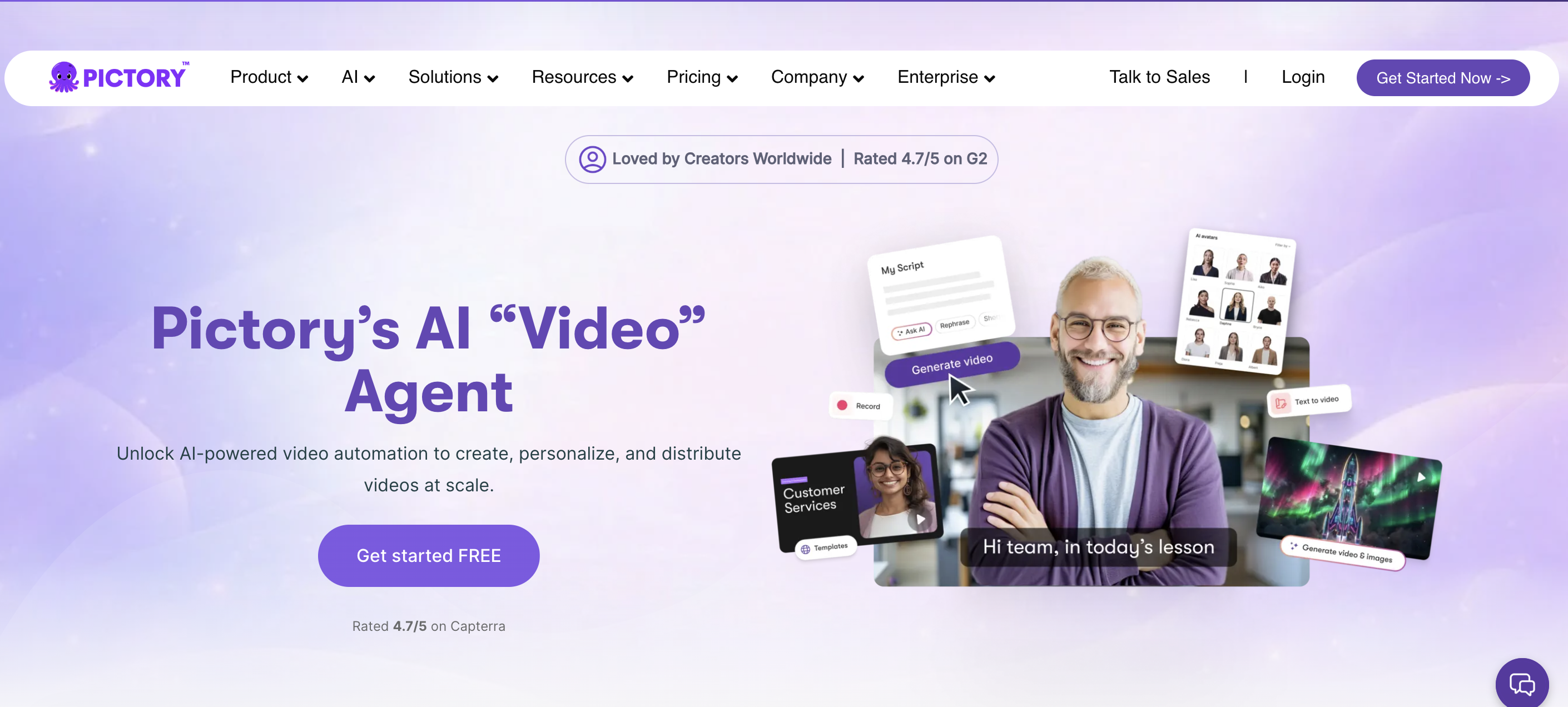
Pictory is a white label AI video generation platform. Agencies use it to produce branded video for clients at scale, converting text, blog posts, and scripts into short-form video with auto-generated visuals, captions, and voiceovers. Its niche is video production, filling the creative slot in an agency's white label stack.
Key white-label features
Pictory's white label features include custom branding on exported videos, API access for programmatic generation, and team workspaces for managing multiple client accounts. The API is built for no-code integration through tools such as Zapier, so agencies can embed video generation into their own workflows or client portals while Pictory handles the rendering infrastructure.
Best use cases
Pictory suits marketing and content agencies that need volume video without a production crew, along with content platforms and eLearning providers repurposing written material into video. It fits teams turning blogs into social clips or webinars into highlights, and it works well when video is a recurring deliverable the agency wants to brand as its own.
Pricing model
Pictory offers subscription plans with white label and API options aimed at agencies and enterprises producing branded video at volume. The model supports monetizing video as a white label service, and API access is the route for agencies embedding generation into their own products. Confirm the current plan that includes white label export and API access before committing.
Credentials and reputation
Pictory is an established AI video platform that appears consistently in white label AI tool roundups, credited for its API-first approach and branded export. Reviewers position it as a practical way to scale video production under an agency brand, and its team workspace and API access are what make it viable for reselling rather than single-user creation.
White Label AI Software Compared
The table below summarizes how the ten platforms line up by primary niche, the core product you resell, and the client each one suits. Use it as a shortlist tool, then verify current terms with the provider.
How to Start Reselling White Label AI Software
Once you have chosen a platform, launching a white label line follows a clear sequence. The work is less about technology than about packaging, pricing, and the client experience.
Start by matching the platform to your service. Choose the option whose core product is what your clients already ask for, using the criteria set out earlier, so you are selling into demand rather than creating it.
Then set your pricing for margin. Work out your wholesale or platform cost per client, decide on the markup that keeps you profitable while staying competitive, and build tiers that map to different client sizes.
Next, brand the client experience completely. Apply your domain, logo, and colors, and check that the vendor is invisible at every touchpoint the client reaches, from the login screen to notification emails.
A branded product that leaks the vendor's name undercuts the whole model. Finally, onboard your first client and treat that engagement as the template you refine, since a smooth onboarding is what turns a single sale into a repeatable process.
Conclusion
The best white label AI software is the one that matches what you actually want to sell. GoHighLevel and Vendasta suit agencies building a broad marketing or reseller business, SuiteDash and AgencyAnalytics serve operations and reporting, and platforms like 10Web, Writesonic, and Pictory cover websites, content, and video.
When the product you want to resell is AI itself, chatbots and voice agents that carry your brand, Stammer.ai is the specialist built for exactly that. Start with a free trial of the Stammer Agency, brand it as your own, and turn AI into a recurring line your clients rely on.