All Blog Posts
Stay up to date on the latest platform updates, new use cases and strategies that are working for other agencies.
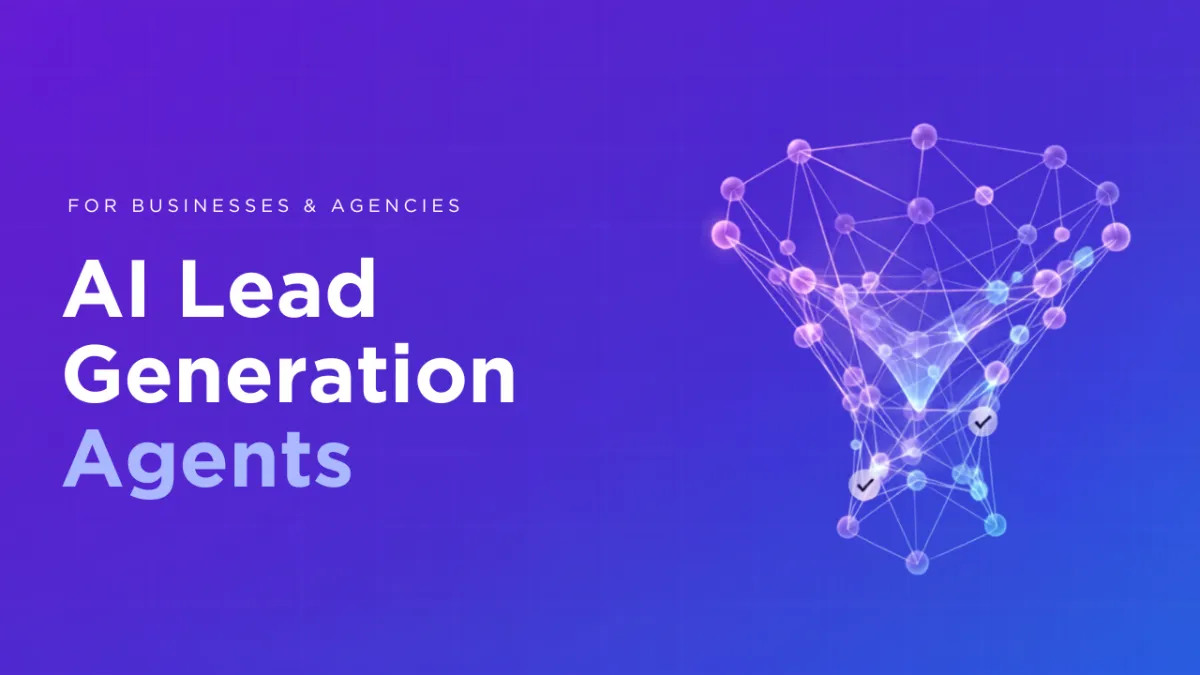
AI Lead Generation Agents: 7 Ways to Capture More Leads
Generating leads is only part of the sales process. The bigger challenge for many businesses is what happens after someone shows interest. A potential customer may visit a website, submit an enquiry, or ask a question, but if the response is delayed, the opportunity can disappear. Sales teams often spend hours sorting through enquiries, following up with prospects, and trying to identify which leads are actually worth pursuing.
An AI lead generation software gives businesses another way to address this gap. It can take an active role in the early sales journey, helping companies make better use of the interest they are already generating. In this guide, we will look at seven practical ways businesses are putting these agents to work and where they can make the biggest difference.
What Are AI Lead Generation Agents?
AI lead generation agents are software systems designed to help businesses identify, engage, and qualify potential customers through automated conversations and workflows.
These agents can understand customer questions, respond based on context, and guide prospects through early stages of the buying process. They use conversational AI to interact with potential customers, gather relevant information, and determine whether a lead is ready for the next step.
The goal is to help businesses understand which conversations have real potential and ensure valuable opportunities do not get lost. AI lead generation agents can support several parts of the sales process, including:
Engaging potential customers: Starting conversations with visitors and responding to enquiries in real time.
Collecting customer information: Gathering details that help businesses understand a prospect’s needs.
Understanding buyer intent: Identifying signals that show whether someone is researching, comparing options, or ready to take action.
Qualifying leads: Asking relevant questions to separate stronger opportunities from general enquiries.
Supporting sales teams: Providing sales representatives with better context before they continue the conversation.
These systems can take different forms depending on the business need. An AI Chatbot software may operate through websites, voice, or messaging platforms, while virtual sales agents can be configured around specific business workflows.
How Do AI Lead Generation Agents Work?
The way businesses generate and manage leads has changed. A prospect may discover a company through a website, advertisement, social media campaign, or referral, but the journey from initial interest to becoming a customer requires multiple touchpoints.
AI lead generation agents help manage these interactions across different stages of the customer journey, from attracting prospects and engaging with them to qualifying leads and following up. This can include automated email outreach, chat-based interactions, and AI outbound calling platforms designed to connect with prospects directly.
Attract → Engage → Qualify → Follow Up → Convert
Instead of treating every enquiry the same, AI agents help businesses create an organised process where prospects receive relevant responses based on their needs, while AI outbound calling services can support timely follow-ups and ongoing lead engagement.
Understanding Prospect Intent
Not every visitor has the same objective. Some are researching their options, while others have a clear need and are closer to making a decision. AI agents can distinguish between these stages by interpreting the answers prospects provide.
For example, an AI agent may ask:
What service are you interested in?
What problem are you trying to solve?
When are you looking to get started?
Are you looking for a specific solution?
This gives businesses a clearer picture of intent than a basic form submission can provide.
Moving Qualified Leads Forward
Once a prospect shows interest and meets the right criteria, the next step is helping them continue their journey. AI agents can support this process by:
Routing qualified opportunities to the right team member
Scheduling the next conversation
Providing sales teams with relevant customer details
Maintaining engagement until a human follow-up happens
This creates a defined handoff point between automated lead management and the next stage of the sales process.
7 Ways Businesses Use AI Lead Generation Agents
1. Capture Website Visitors and Turn Them Into Leads
A website visitor does not always convert on their first visit. They may be interested in a product, comparing options, or looking for answers before making a decision. If there is no immediate way to engage them, many potential opportunities disappear before a business ever knows they existed.
AI lead generation agents give businesses a way to turn some of that anonymous traffic into identifiable prospects. Rather than depending entirely on static forms, the agent can collect useful information during the visitor’s interaction with the site, such as:
Name and contact details
The service or product they are interested in
Their specific requirements
Their preferred timeline
That information can then be stored in the business’s existing systems, turning previously unknown website activity into lead data that can be tracked and acted on.
2. Qualify Leads Before They Reach Sales Teams
Every enquiry does not hold the same value. A business may receive dozens of messages each week, but only some will match its ideal customer profile. Without proper qualification, sales teams often spend time reviewing enquiries that are unlikely to convert. This slows down the sales process and takes attention away from stronger opportunities.
AI lead generation agents help solve this by asking targeted questions during the initial conversation. Instead of collecting basic contact details only, they can gather information that helps determine whether a prospect is a good fit.
Depending on the business, the agent may identify:
What problem the customer wants to solve
Which service they need
Their budget range
Their expected timeline
Whether they are ready to take the next step
A software company may separate individual users from business or enterprise prospects. A home service company might use location, project type, and urgency as its qualifying criteria. The qualification criteria can therefore reflect what a valuable lead actually looks like for that business.
3. Automate Lead Follow-Ups and Keep Prospects Engaged
Some leads go quiet even after showing interest. The problem is often timing: the prospect is not ready to act during the first interaction, and the business does not reconnect when circumstances change.
AI lead generation automation can keep those opportunities active through scheduled or behaviour-based follow-ups. A prospect who requested pricing, viewed a service, or stopped midway through an enquiry can receive communication based on that earlier activity.
This makes follow-up less dependent on a salesperson remembering when to reconnect and gives businesses a more deliberate way to manage longer buying cycles.
4. Provide Instant Sales Assistance Across Customer Channels
Prospects often move between different communication channels before making a decision. Someone may start with a website enquiry, continue through a message, and later prefer a phone conversation. Managing these interactions consistently can become difficult as enquiry volume grows.
AI lead generation agents help businesses maintain continuity across these touchpoints by keeping conversations available wherever customers choose to engage. This allows prospects to continue getting support without having to repeat their questions or wait for a team member to become available.
The main advantage is continuity. When channels are connected properly, the customer does not have to start from zero each time the conversation moves from one touchpoint to another.
5. Identify and Re-Engage Missed Sales Opportunities
Many businesses already have valuable opportunities hidden in their existing customer data. These may include previous enquiries, unfinished conversations, or prospects who showed interest but never completed the next step. The challenge is that sales teams often prioritise new enquiries and may not have enough time to revisit older opportunities.
Older lead databases can also contain prospects whose circumstances have changed since their original enquiry. AI agents can help businesses revisit these dormant records and identify whether a previous "not now" has become a current opportunity. This is useful for businesses with large historical databases that would be impractical to review record by record.
6. Support Sales Teams With AI-Powered Insights and Automation
Individual sales conversations can reveal patterns that are difficult to spot when each interaction is reviewed in isolation. Repeated objections, recurring questions, and shifts in prospect behaviour can provide useful signals about the wider pipeline.
AI-powered sales agents can help surface these patterns across larger volumes of conversation data. Teams can then use those findings to refine messaging, identify common friction points, and understand where prospects tend to lose interest. With clearer information available, sales teams can approach conversations with better preparation and create more relevant responses for each prospect.
For growing businesses, this creates a stronger connection between customer interactions and sales decisions. Instead of relying only on manual notes or scattered information, teams can use AI-driven insights to understand their pipeline and improve how they manage opportunities.
7. Help Agencies Build and Sell AI Lead Generation Solutions
AI adoption is creating a new opportunity for agencies that want to add technology-based services to their existing offerings. Businesses are looking for practical ways to use AI, but many do not have the expertise or resources to build these solutions themselves.a
Agencies can bridge this gap by creating customised AI solutions for different industries and client needs. With a white-label AI software, they can deliver these solutions under their own brand without developing the underlying infrastructure from the ground up. This allows agencies to move beyond traditional project-based work and create ongoing service relationships.
For agencies, this creates a service category that can sit alongside existing marketing, CRM, or automation work. The value lies in configuring and maintaining the solution for each client rather than developing the core technology themselves.
AI Lead Generation Agents vs Traditional Lead Generation
Traditional lead generation usually depends on a combination of campaigns, forms, manual outreach, and sales team follow-up. While these methods can generate opportunities, managing every interaction becomes more difficult as the number of enquiries increases.
The main difference lies in how information moves through the process. Traditional lead generation often relies on separate tools for acquisition, data collection, and sales management. Agent-based systems can add a decision-making layer between those stages.
These approaches can also work together. Existing acquisition channels do not need to disappear when agent-based systems are introduced; the technology can be added to selected parts of an established lead management process.
How Businesses Can Choose the Right AI Lead Generation Solution
Selecting an AI lead generation software is not only about comparing features. Businesses need to consider whether the platform fits their goals, existing systems, and future requirements. Before choosing a solution, companies should evaluate a few important factors:
1. Customisation Options
Every business has its own processes, brand requirements, and customer expectations. A suitable platform should allow businesses to adjust settings, workflows, and experiences according to their specific needs rather than forcing them into a fixed structure.
2. Integration Capabilities
An AI platform should work alongside the tools a business already relies on. Compatibility with existing software, platforms, and workflows helps create a connected technology setup.
3. Scalability
The right solution should support growth over time. Businesses should consider whether the platform can handle increased usage, additional requirements, and expanding operations as their needs develop.
4. Ease of Management
A platform should be practical to manage after implementation. Businesses and agencies should look for solutions that make it simple to update, monitor, and adjust their AI systems when changes are needed.
5. Brand Control
For agencies and companies offering AI-powered services, control over the customer-facing experience can be important. Features such as custom branding and personalised configurations can help create a solution that aligns with the business identity.
The best AI lead generation software is the platform that fits naturally into a business’s operations and provides the flexibility needed for long-term use.
FAQS
Do small businesses benefit from AI lead generation agents?
Yes. Small businesses can use AI lead generation agents to handle customer enquiries efficiently without needing a large sales or support team. They can be useful for companies that receive regular customer questions but have limited resources to manage every interaction manually.
Are AI lead generation agents difficult to set up?
The setup process depends on the platform and the level of customisation required. Many modern AI solutions are designed with user-friendly interfaces, allowing businesses to configure workflows, connect existing tools, and adjust their systems without needing advanced technical knowledge.
What industries can use AI lead generation agents?
AI lead generation agents can be applied across many industries where businesses regularly receive customer enquiries. Common examples include professional services, real estate, healthcare, home services, education, and agencies.
How accurate are AI lead generation agents when handling customer conversations?
The accuracy depends on factors such as the quality of the information provided, how the system is configured, and the complexity of customer requests. Businesses should regularly review and improve their AI workflows to maintain reliable interactions.
Can agencies offer AI lead generation services to their clients?
Yes. White-Label AI Agencies can package AI lead generation solutions as part of their service offerings. This allows them to help clients adopt AI-based systems while creating additional opportunities through automation-focused services.
Final Thoughts
AI lead generation agents are most useful when they solve a specific weakness in an existing process. That could mean making better use of website traffic, bringing dormant records back into consideration, or extracting useful patterns from sales conversations. The important question is therefore not whether a business should "use AI for lead generation." It is where an agent can add enough value to justify changing the current workflow.
Starting with a clearly defined problem makes that decision much easier and gives businesses a practical way to evaluate whether the technology is delivering meaningful results.

Start selling AI Agents with Stammer.ai
Get started today!