How to Start an AI Automation Agency (Step-by-Step Guide)
Businesses are drowning in repetitive work, missed calls, slow responses, and leads slipping through the cracks. At the same time, customers expect instant replies and 24/7 availability. Most companies recognize the problem, but hiring more staff does not solve it efficiently.
AI automation is changing how businesses handle these challenges, and it is creating a new kind of opportunity for agencies.
Instead of selling one-off services, AI automation agencies build systems that respond to customers, capture leads, and streamline operations in real time. Demand continues to grow, but many people entering this space either overcomplicate the setup or struggle to turn it into a scalable business.
This guide focuses on what actually works.
In the sections ahead, you will learn how to choose a profitable niche, define an offer businesses will pay for, set up your first AI system, and build a repeatable agency model that generates consistent revenue.
What Is an AI Automation Agency?
An AI automation agency builds and implements systems that handle routine business tasks using artificial intelligence. It combines elements of a service and a product. Instead of delivering only one-time work, the agency sets up automation systems that continue to operate after deployment, often with ongoing access or support.
This approach differs from traditional marketing or development agencies. Conventional agencies typically rely on continuous manual effort, such as running campaigns, designing assets, or building custom features from scratch. An AI automation agency focuses on creating systems that perform specific functions on their own, reducing the need for constant human involvement.
The core services usually center around a few key areas:
AI chat automation: Systems that manage customer conversations, respond to inquiries, and guide users through predefined actions.
AI voice agents: Tools that handle phone-based interactions, including answering calls and managing basic communication flows.
Workflow automation: Processes that connect different tools and automate repetitive tasks within a business operation.
Businesses are adopting these solutions because they address everyday operational challenges. Automation helps reduce reliance on manual work, improves response speed, and allows businesses to stay available beyond standard working hours. These practical benefits make AI automation a relevant addition to how modern businesses operate.
Why AI Automation Agencies Are Growing Fast
Demand is rising because businesses need faster and more consistent ways to handle customer interactions. Small and medium-sized businesses, especially local service providers, face constant inquiries and often lose opportunities due to delays or missed responses.
The model also supports recurring revenue. Once an AI system is deployed, it continues to deliver value, which allows agencies to charge ongoing fees instead of relying only on one-time projects.
A large portion of business communication is repetitive. Tasks like answering common questions, handling initial lead intake, and routing requests can be automated, which reduces manual workload and operational strain.
At the same time, entry barriers have dropped. White-label platforms remove the need to build infrastructure from scratch, allowing agencies to focus on packaging and delivering solutions instead of technical development.
Pricing and monetization also play a major role in how these agencies grow. Many agencies structure their offers around usage, tiers, and value-based billing rather than flat pricing. You can see a detailed breakdown of how pricing models work in practice.
Skills You Actually Need (No Coding Required)
You do not need a technical background to start an AI automation agency. Most of the work depends on understanding business problems, communicating solutions, and setting up simple systems rather than writing code.
The most important skill is sales and client acquisition. You need to be able to identify potential clients, start conversations, and clearly explain how automation improves their business outcomes. Without this, even a strong setup will not generate revenue.
Equally important is problem-solution thinking instead of focusing on tools. Clients do not care about the technology itself. They care about missed leads, slow response times, and operational inefficiencies. Your job is to translate these problems into clear solutions.
A basic understanding of a few core concepts is enough to operate effectively:
Conversational flows: Knowing how a user moves through a chatbot or voice interaction, from first message to final action.
Lead funnels: Understanding how prospects are captured, qualified, and moved toward booking or purchase.
CRM workflows: Knowing how leads are stored, tracked, and followed up inside a customer management system.
Industry knowledge is definitely useful. If you understand a specific niche, it becomes easier to identify pain points and position your offer more effectively.
Step-by-Step: How to Start an AI Automation Agency
Starting an AI automation agency works best when you follow a structured process instead of trying to offer everything at once. The goal is to narrow your focus, build a simple offer, set up your system, and then refine it based on real client demand.
Step 1: Choose a Profitable Niche
The first step is selecting a niche where automation has clear and immediate value.
Common examples include:
Dental clinics
Real estate agencies
Home service businesses (plumbing, HVAC, cleaning)
SaaS companies
A focused niche improves conversion rates because your messaging becomes specific instead of generic. Businesses respond faster when they feel the solution is designed for their exact workflow.
Strong niches usually share these traits:
High volume of inbound leads or inquiries
Repetitive customer communication
Time-sensitive responses (missed leads equal lost revenue)
Step 2: Define Your Core Offer
Once the niche is clear, define a simple and focused offer.
Stick to one or two core services:
AI chatbot for lead capture
AI voice agent for handling calls
The key is to sell outcomes, not tools. For example, instead of saying “AI chatbot setup,” position it as “helping businesses book more appointments automatically.”
Avoid expanding your offer too early. A narrow offer is easier to sell, deliver, and optimize.
Step 3: Set Up Your AI Infrastructure
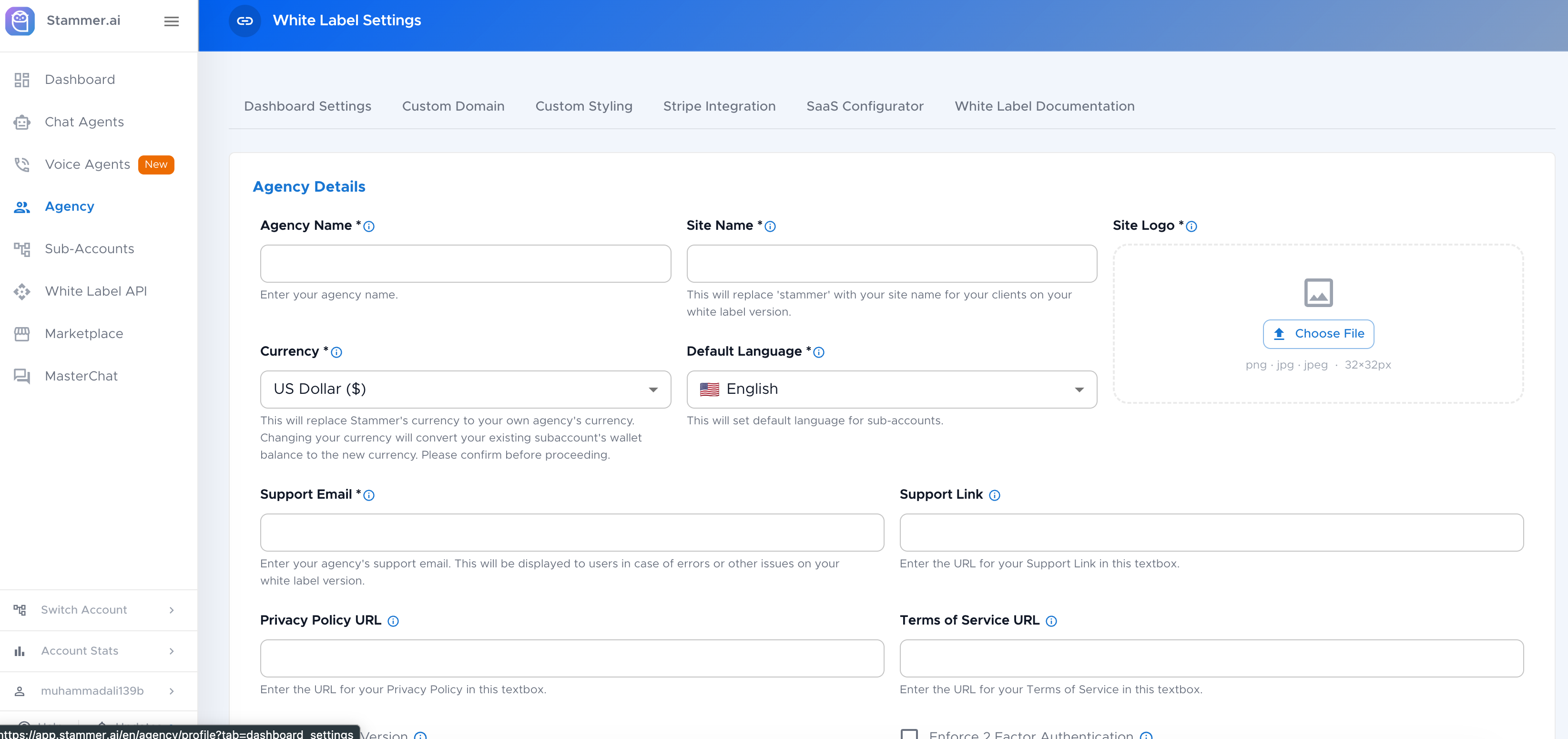
After defining your offer, set up the system you will use to deliver it.
Using Stammer AI, you can:
Build AI chat and voice agents
White-label them under your own brand
Manage client accounts and subscriptions in one place
At this stage, keep the setup simple and functional. Focus on:
Training the AI with relevant business information using a knowledge base
Connecting it to essential tools like websites, CRMs, or phone systems
The goal is not to build complex systems, but to create a working solution you can deploy for your first clients quickly.
Step 4: Build a Simple Demo (Not a Full Product)
Create working AI agent tailored to your chosen niche. Do not try to build a full system with multiple features at this stage. Focus only on what a real business would actually use.
Use realistic scenarios such as:
Frequently asked questions
Appointment booking flows
The goal is to simulate real interactions that a business owner can immediately understand and relate to. A working demo is far more effective than a pitch deck because it shows actual outcomes instead of explaining them.
Step 5: Get Your First Clients
Focus on direct outreach instead of waiting for inbound leads.
Effective methods include:
Cold email to targeted businesses in your niche
Loom videos showing a quick audit of their current customer flow
LinkedIn outreach with short, problem-focused messages
Your initial offer should reduce friction for the client:
Free audit or live demo of their use case
Low-risk entry such as a trial period or small setup fee
The objective is not to sell big contracts immediately, but to get the first few implementations live.
Step 6: Price Your Services for Recurring Revenue
Structure your pricing around monthly recurring revenue rather than one-time payments.
Typical range:
$200 to $1000+ per month depending on the scope and value delivered
Pricing should reflect business outcomes, not the number of features included. Focus on what the system improves, such as lead capture or response speed.
You can also include:
One-time setup fee for implementation and onboarding
Usage-based billing if the system scales with volume or interactions
Understanding how AI businesses make money can help you refine your own pricing strategy.
How to Deliver Results for Clients
Delivering results in an AI automation agency comes down to tracking clear outcomes, improving system performance, and keeping reporting simple enough that clients actually understand it.
Start by defining measurable KPIs before or at the time of deployment. These typically include:
Leads captured through chat or forms
Calls handled by AI voice agents
Appointments booked directly from automation
These metrics keep the focus on business impact rather than technical performance.
Next, continuously optimize the system based on real usage. Most improvements come from refining:
Conversation flows to reduce drop-offs and confusion
Response accuracy to ensure users get correct and relevant answers
Small adjustments in how the AI handles interactions often lead to significant improvements in conversion rates.
Finally, maintain regular reporting without overcomplicating it. A summary of key metrics, performance trends, and improvements can demonstrate value and build long-term trust.
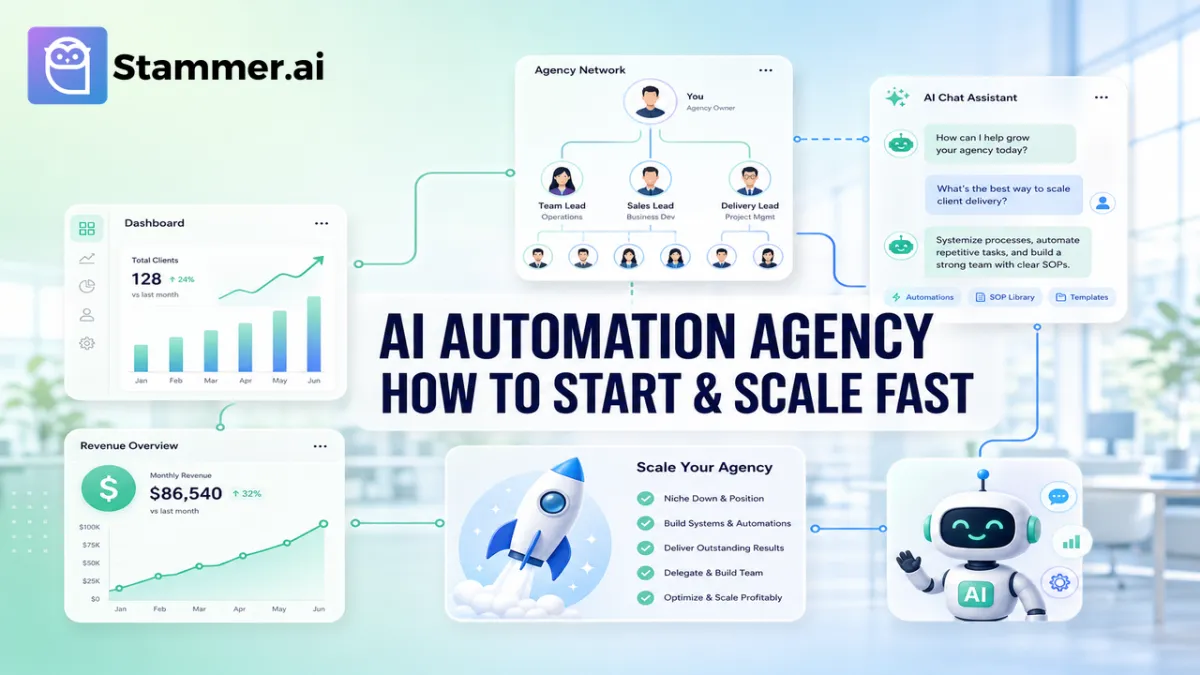
How to Scale an AI Automation Agency
Scaling an AI automation agency is less about adding more tools and more about removing variability from delivery, sales, and onboarding. The goal is to make results repeatable across multiple clients without increasing operational complexity.
Standardize Your Offer
To scale efficiently, convert your services into fixed packages. Instead of customizing every solution from scratch, define what you deliver and how it works for each client.
This reduces:
Time spent on setup and planning
Decision fatigue during sales calls
Inconsistency in delivery quality
Standardization also makes it easier to train others and delegate work as you grow.
Build Repeatable Systems
Create systems that can be reused across clients with minimal changes.
This includes:
Pre-built templates for chat and voice agents
Reusable automation workflows for common use cases
Structured onboarding SOPs that guide every new client through the same process
The more you systemize delivery, the less dependent your agency becomes on manual effort.
Focus on Distribution
Once delivery is consistent, growth depends on distribution. Identify the outreach channel that brings the best results and focus on it instead of spreading efforts across multiple channels.
Strengthen credibility through:
Documented case studies
Clear before-and-after results
Real performance improvements from existing clients
Proof-driven marketing compounds over time and reduces friction in closing new deals.
Example Use Case (Realistic Scenario)
A local dental clinic receives a steady flow of inquiries through its website and phone line. However, the front desk team cannot respond to every message or call immediately, especially during peak hours and after closing time. As a result, potential patients often leave without booking an appointment.
The main problem is missed opportunities. Every unanswered call or delayed response increases the chance of losing a lead to a competing clinic.
To solve this, the clinic implements an AI automation setup consisting of:
An AI chatbot on the website to handle visitor questions and capture appointment requests
An AI voice agent to answer incoming calls, provide basic information, and schedule bookings
These systems ensure that every inquiry receives an instant response, regardless of time or staff availability.
Tools You Need to Run the Agency
The core platform you use for building and managing AI systems is Stammer AI. It handles the creation and deployment of AI chat and voice agents, along with client management and subscriptions under your own brand.
Beyond that, only a few supporting tools are needed:
CRM (optional): Used to track leads, conversations, and client relationships if you need additional organization.
Email outreach tool: Helps you run cold email campaigns and manage outbound client acquisition.
Scheduling software: Used to book calls and demos with potential clients without manual coordination.
Keeping the stack lean ensures faster execution, fewer technical distractions, and a clearer focus on revenue-generating activities.
Conclusion
An AI automation agency does not need to start with complex systems or a large service lineup. The most important step is getting real clients and validating that your offer solves an actual business problem.
Focus first on securing 1 to 3 clients. This early stage is about proving that your solution works in a real environment, not building the perfect setup. Once you have active clients, you can refine your delivery based on real feedback instead of assumptions.
Only expand after you have a working offer that consistently delivers results. Adding new services or scaling operations too early often creates unnecessary complexity and slows down growth.
Systems, processes, and scaling become important after revenue starts coming in consistently. At that point, you can standardize delivery, improve efficiency, and expand your reach with confidence backed by real performance.